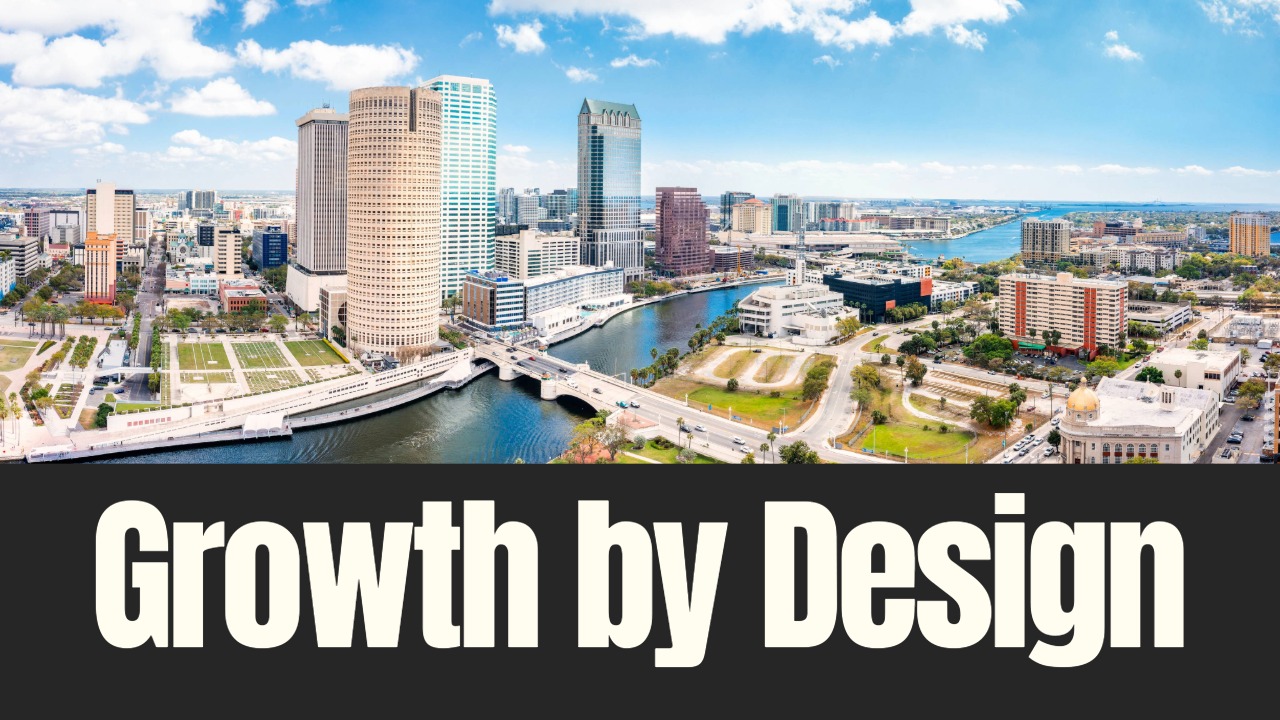

Tampa Bay’s growth is no longer a moment. It is the result of years of decisions made early, repeated often and allowed to compound.
What is happening now did not come from a single deal or one development cycle lining up just right. It is the outcome of long-horizon investment, coordinated land use and institutions designed to endure.
The region did not suddenly become attractive. It positioned itself to be.
That distinction matters. Tampa Bay is not growing because capital is chasing the next hot market. It is growing because the fundamentals of the Tampa Bay economy are aligned.
RELATED: The state of Tampa’s economy in 2025
Former Tampa Mayor Bob Buckhorn, who is expected to once again run for mayor in 2027, captured that mindset during his remarks at TBBW’s 2025 Apogee Awards.
“When the world told us we would be a third-tier city forever, you said not on my watch,” Buckhorn said. “You believed in our capacity to be a great city. And out of that moment, we began to get up off the mat.”
Data, capital and execution now reinforce that belief.
The infrastructure that made this cycle possible
Across commercial real estate, hospitality and entrepreneurship, Tampa Bay is showing layered growth that signals durability rather than speculation.
JLL research shows that lifestyle-driven mixed-use office districts consistently outperform traditional office markets. These environments command 32% higher rents, lease up twice as fast and maintain far lower vacancy rates.
While lifestyle office represents roughly 4% of total US inventory today, JLL projects that share could reach 30% by 2040.
RELATED: Tampa office market is changing fast: What comes next?
Tampa Bay leaned into this model early.
Water Street, Midtown and Gasworx were never designed as office projects alone. They combine residential density, retail, hospitality and public space in ways that support daily life rather than just working hours.
That mix helped Tampa avoid the sharper office corrections seen in faster-building Sun Belt markets.
Instead of overshooting demand, new supply has been absorbed steadily. The result is a market that feels active without feeling fragile.
The same pattern is visible in hospitality.
Luxury operators like The Tampa EDITION did not arrive by accident. According to General Manager Chris Southwick, Tampa met the criteria global brands look for well before national attention followed.
RELATED: The Tampa EDITION’S Chris Southwick on Tampa’s luxury market
“Luxury isn’t being imported anymore,” Southwick said. “It’s being built right here.”
Tampa is no longer trying to prove potential. It is executing.
A prime downtown block signals intent
One of the clearest indicators of how Tampa is thinking about its next phase sits in the heart of downtown Tampa.
The City of Tampa has put the Tampa Police Department headquarters site on the market for $36M. The property spans just over an acre and occupies a full block bounded by Franklin Street, Florida Avenue, Madison Street and Kennedy Boulevard. Proposals are due February 6, 2026.
RELATED: City of Tampa puts police HQ on the market for $36M. Why?
Any buyer will be responsible for demolition, environmental review, rezoning and redevelopment. This is not a passive transaction. It is an invitation to define the next use of a rare downtown site.
City officials have described the parcel as a once-in-a-generation opportunity. Some council members have raised concerns. The broader signal remains clear.
Prime downtown land is scarce, and Tampa is asking the private market to show what it can build next.
Local developer Joshua Pardue framed it plainly. The value, he said, “is the location.”
In his view, the current use is no longer the best and highest use for Franklin Street. The corridor should evolve into a more active connection between downtown and redevelopment north of the core.
Strip away the project specifics and the takeaway remains. Tampa is leaning into density, walkability and corridors designed to support long-term economic gravity.
Corporate relocations shift from trend to pattern
Corporate decision-making now reflects that confidence. Recent relocations follow a consistent pattern.
Wagamama moved its US headquarters from New York to Tampa to support national expansion, citing access to talent.
Orion Edge relocated from Colorado and committed $20M in investment, pointing to Tampa Bay’s defense ecosystem and business climate.
LGE Design Build selected Tampa as an East Coast hub, entering Florida with nearly 500,000 square feet of logistics and industrial projects already under contract.
RELATED: Defense contractor moving HQ to Tampa and invest $20M in region
The Tampa Bay Economic Development Council reported 29 closed projects in its most recent fiscal year, creating more than 2,200 jobs and generating over $273M in capital investment.
These are not speculative announcements. They are operational decisions.
Multifamily stability becomes a competitive advantage
Housing data reinforces the same theme.
Newmark reported national multifamily returns of 5.48% in Q3. Tampa posted returns of 6.5%, outperforming markets like Atlanta and Charlotte and landing near Nashville.
RELATED: Tampa multifamily market outperforms Sun Belt in new Q3 report
The takeaway is not acceleration. It is balance.
Tampa added supply during the recent development cycle without the sharp corrections seen in markets that overbuilt. Absorption has been steadier.
As underwriting tightens nationally, investors are increasingly treating Tampa less like a boom market and more like a durable one.
Entrepreneurship is now a core economic engine
That durability extends into Tampa Bay’s startup ecosystem.
Embarc Collective, a nonprofit platform built to support serious tech founders, offers a clear view into how long-horizon strategy translates into economic impact.
Tim Holcomb, who leads Embarc Collective, describes the shift as cumulative rather than explosive.
“What’s happening in Tampa Bay isn’t a moment,” Holcomb said. “It’s the outcome of a disciplined, long-horizon strategy.”
READ: LATEST TAMPA BUSINESS NEWS
In 2025 alone, applications to Embarc Collective increased by more than 40% compared to 2024.
Over the past five years, companies in its ecosystem created more than 1,200 high-skilled jobs and raised over $600M in angel, venture and growth equity.
Holcomb said the economic effect is already measurable.
“Companies in our ecosystem are now generating roughly $100M annually in direct wages and compensation for Floridians, while attracting more than $100M each year in seed, venture and growth capital that flows directly into Florida-based innovation,” he said.
That capital does not stop with startups. It moves through housing, consumer spending, professional services and the broader local economy.
Technology moves from promise to platform
The same long-horizon thinking is reshaping Tampa Bay’s technology ecosystem.
What once felt fragmented is beginning to operate as a platform.
spARK Labs by ARK Invest represents that shift. Formerly the Tampa Bay Innovation Center, the nonprofit rebranded in late 2025 to reflect a sharper focus on disruptive technologies and a deeper connection to national research and capital.
Now incubating 25 companies, spARK Labs launched a new scaling program in October. Founders receive one-on-one support, access to ARK Invest’s research team and connections to advisors and capital partners.
READ: LATEST TAMPA BAY REAL ESTATE NEWS
Rebecca Brown, CEO of spARK Labs by ARK Invest, said demand is coming from across the economy.
“Entering the new year, the speed of innovation is remarkable,” Brown said. “Demand is coming from every sector, and founders are rising to the challenge with smarter, more impactful solutions.”
spARK Labs focuses on technologies ARK Invest tracks as transformational, including artificial intelligence, robotics, energy storage, blockchain and multiomics biology.
“These technologies are going to permeate every industry, every sector and every company,” Brown said.
ARK Invest founder and CEO Cathie Wood has pointed to Tampa Bay’s proximity to MacDill Air Force Base as a long-term advantage as advanced technologies increasingly intersect with defense and enterprise systems.
Innovation here is no longer a headline. It is becoming infrastructure.
The consumer remains cautious but intentional
All of this growth still runs through one constraint. The consumer.
According to McKinsey’s ConsumerWise research, US consumer sentiment declined through late 2025 as inflation and job security concerns remained elevated. Nearly 75% of consumers reported trading down in at least one category.
At the same time, 39% still planned to splurge selectively, often on smaller indulgences tied to experience and identity.
David Habib of Clearwater-based Yo Mama’s Foods sees that shift daily through national retail demand.
“We’re optimistic heading into 2026, but consumers remain highly value-driven,” Habib said.
Yo Mama’s Foods ships to 24,000 stores nationwide, giving Habib a broad view into household behavior.
READ: DAVID HABIB’S 2024 TBBW COVER STORY
Value, he said, is no longer defined by price alone.
“Demand for healthier, clean label options continues to grow as shoppers look for products that deliver both nutrition and value without compromise,” Habib said.
Consumers are pulling back without shutting down. For markets built on fundamentals rather than excess, that flexibility matters.
Where the risks remain
None of this suggests Tampa Bay is immune to pressure.
Higher interest rates continue to affect financing and underwriting. Insurance costs remain a concern for property owners and developers. Infrastructure must keep pace with population growth to protect quality of life.
UPDATE: The economic impact of the Fed’s latest rate cut on Tampa Bay
There are also strains beneath the surface.
Federal program cuts, tighter state budgets and changes to local grant structures are placing pressure on nonprofits that provide food access, housing support and workforce services.
“That is federal, state and now local,” said Kendall Webb, founder of Charity Bridge Fund. “It is very risky for the nonprofits that are locally supporting the community.”
LEARN MORE: New platform links Tampa Bay donors to nonprofits losing funding
The risk is not slowing down. The risk is imbalance.
Writing the next chapter
What separates Tampa Bay from many peer markets is balance.
Growth has not been driven by a single industry or one oversized bet. It has been reinforced across real estate, hospitality, entrepreneurship, technology and population growth.
That diversification has helped the region avoid sharp corrections while maintaining momentum amid shifting national conditions.
As Buckhorn reminded the room at the Apogee Awards, the story is not finished.
“We don’t have to accept mediocrity,” he said. “We have become everything that we have aspired to be, and that journey has just begun.”
READ: Tampa Bay’s Top Companies No. 1: Jabil
The next chapter for Tampa Bay will not be written by hype.
It will be shaped by employers deciding where talent can thrive, by developers prioritizing projects that age well and by investors who value patience over speed.
The chapters ahead remain unwritten. Tampa Bay has earned the discipline to define them deliberately.
Stay Connected
Sign up for TBBW’s newsletter
Watch TBBW’s Podcast
Follow TBBW on Social Media
Read More TBBW stories