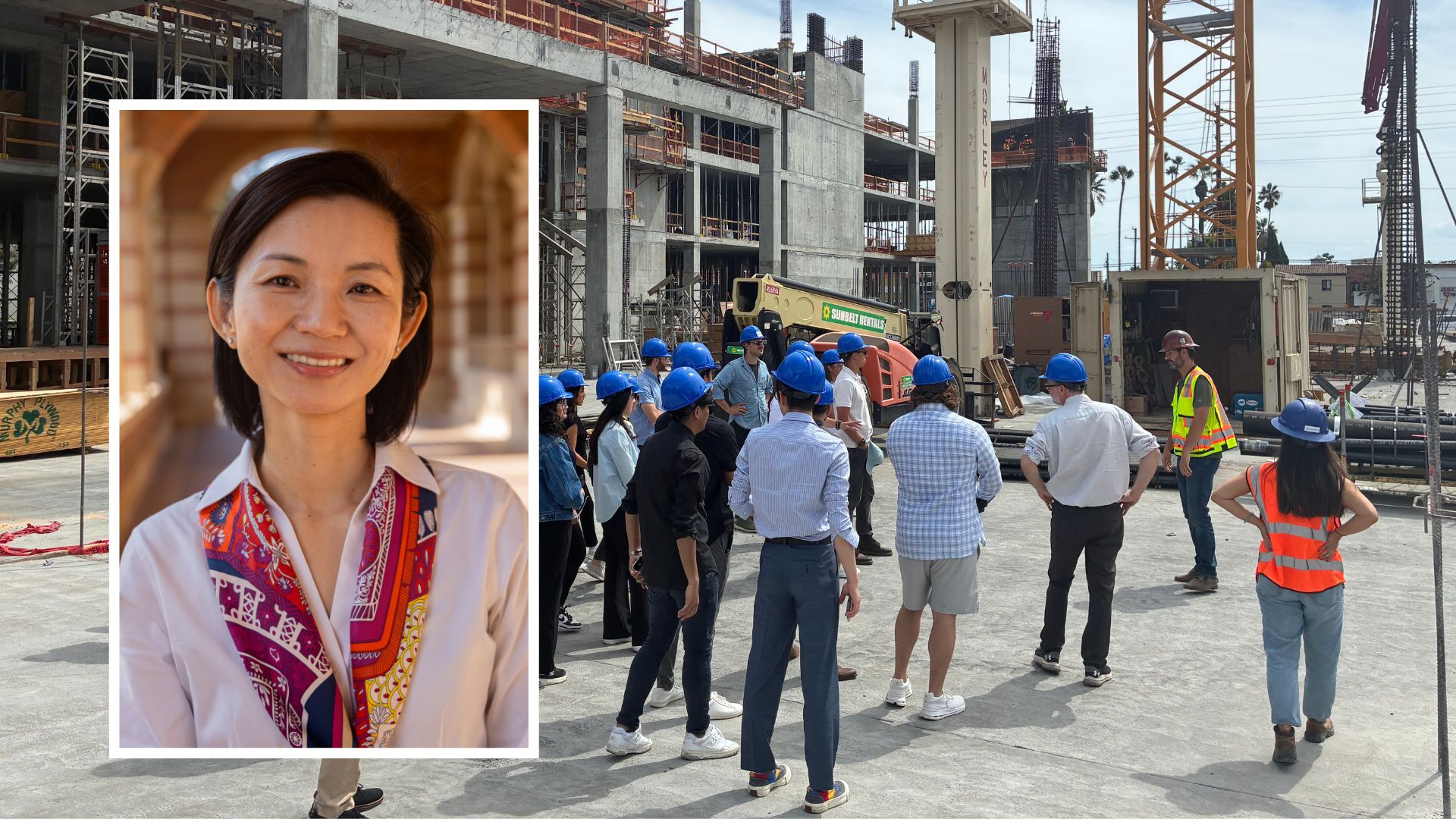

You came to UCLA Luskin with senior leadership experience at companies like Tesla and Walmart. What made this the right moment to step back into the classroom, and why UCLA’s MRED specifically?
I have spent most of my career in corporate real estate, primarily focused on execution — new site selection, store openings, service facilities, and office locations. At Walmart in particular, I was fortunate to gain broad exposure across construction, project management, commercial leasing, and asset management, which gave me a very comprehensive understanding of how large-scale real estate organizations operate.
At this point in my career, I felt ready to step back and think more deeply about the why behind development — not just how to execute projects, but how to plan commercial real estate for the long term in a way that is sustainable and resilient. UCLA Luskin stood out because the MRED program is grounded in public impact. It focuses on preparing future real estate leaders to think beyond short-term returns and consider sustainability, resilience, and community outcomes as central parts of development.
The MRED program emphasizes sustainability and affordable housing. How does this approach differ from how real estate has traditionally been taught or practiced?
Traditionally, real estate education and practice have focused heavily on profitability and transactional returns. While financial performance is still critical, the MRED program challenges us to think about how sustainability can be thoughtfully integrated into long-term financial goals rather than treated as an afterthought.
Two aspects of the program really stood out to me. First, sustainability as not just a concept but a central tenet of the curriculum. Second, the curriculum prioritizes applied learning. Many of our courses are built around real case studies, and we frequently connect with senior real estate leaders throughout the program. For someone with extensive industry experience, this approach allows me to stay connected to market leaders and continue to grow my professional network. Approximately 70% of our courses are taught by senior industry leaders, not just academic lecturers. 
As a member of the inaugural MRED cohort, what has your experience of the program been like so far?
The school has made a significant investment in our cohort and is deeply committed to our success. As members of the inaugural class, we are actively shaping the culture of the program. Our cohort is highly diverse, with peers from backgrounds in development, finance, design, and policy, which makes our discussions really interesting and informative. The experience closely mirrors a professional environment — you are constantly coordinating different perspectives, like a conductor, bringing together construction, design, finance, legal, and policy considerations into a cohesive whole.
You bring a global real estate perspective from China and multinational firms. How has studying real estate in Los Angeles expanded or challenged the way you think about markets and development?
Coming from China, I was accustomed to faster development timelines and more centralized decision-making. Studying real estate in Los Angeles has challenged me to think much more deeply about community engagement, regulatory complexity, and the intersection between the public and private sectors.
This experience has shifted my perspective from simply thinking about getting a project to the finish line to thinking more holistically about long-term community value. It is not just about speed and scale, but about inclusion, collaboration, and sustainability. This type of learning has prepared me to approach development with a more global and holistic mindset.
How do you hope to carry forward your commitment to inclusive leadership as you continue your real estate career after UCLA?
I strongly believe that better outcomes come from listening to diverse perspectives. Real estate remains a male-dominated industry, and women’s voices are still underrepresented in leadership and decision making. We need to be seen and heard.
As I move forward, I hope to mentor younger women who are building their careers in real estate. I also want to continue balancing professional success with social responsibility, ensuring that development decisions reflect inclusive leadership and long-term impact.
Any final thoughts or advice for prospective MRED students?
The MRED program offers an exceptional level of support and real-world engagement. Each student is paired one-on-one with an industry mentor, which provides invaluable guidance and perspective.
One of the most impactful experiences for me has been our capstone project. We were tasked with identifying a real property, visiting the site, engaging brokers, developing a proposal, and pitching it to real investors. That experience truly placed us in a real-world development environment and reinforced how closely the program is connected to industry practice. For anyone considering MRED, this program is deeply practical, highly engaged, and designed to prepare you for the realities of today’s real estate landscape.