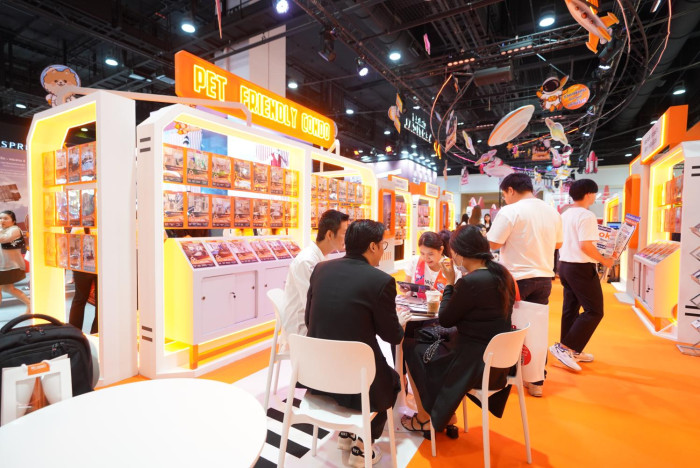
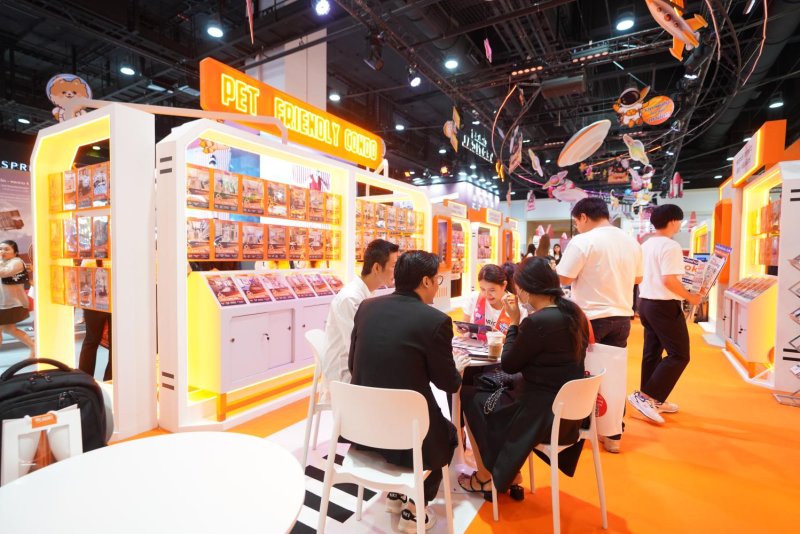
 Potential buyers look at housing projects at the House and Condo Expo. Affordability, risk management and liquidity preservation are recommended strategies for developers in 2026. Wisuttipong Rodpai
The residential property market closed 2025 under heavy pressure from weak purchasing power, tight mortgage lending and external shocks, prompting developers to recalibrate strategies for 2026 around affordability, risk management and liquidity preservation.
Tritecha Tangmatitham, managing director of SET-listed developer Supalai, said the company will prioritise risk management in 2026, focusing on affordable housing priced between 4-8 million baht, and expanding into new and existing provincial markets.
He said Supalai plans to grow in provinces such as Suphan Buri, while reinforcing its presence in high-potential markets like Chon Buri and Chiang Mai, where real demand remains despite broader economic headwinds.
“In 2026, the property market will remain challenging, with intense competition in sales prices per unit,” Mr Tritecha said, adding buyers will remain price-sensitive and increasingly focused on promotions rather than design or additional functions.
Overall demand still exists, but concerns over affordability are becoming more pronounced, reshaping purchasing decisions and forcing developers to compete more aggressively on pricing and incentives, he said.
Supalai expects its 2025 performance to soften slightly from the previous year, reflecting weaker purchasing power, a sluggish condo market and lingering effects from the earthquake earlier this year.
“The condominium segment underperformed compared with 2024, while low-rise housing recorded a slight contraction, highlighting diverging dynamics across residential product types,” said Mr Tritecha.
Looking ahead, he said conditions could improve modestly in 2026, with the condo market relying heavily on new project launches, though overall growth is likely to remain limited.
For low-rise housing, Supalai anticipates the market to stabilise next year or post a marginal change, as pressures gradually ease even though household repayment capacity is unlikely to improve significantly.
Competition for land banks among developers is also expected to cool, as companies prioritise liquidity preservation over aggressive expansion amid ongoing market uncertainty.
Mr Tritecha said the outlook remains difficult to predict, but conditions are unlikely to deteriorate further after a year marked by unprecedented challenges, including an earthquake and severe flooding in southern provinces.
He said the economic slowdown and weaker demand could cause land prices to stagnate or decline for at least two years, easing one of the industry’s long-standing cost pressures.
From Supalai’s perspective, 2026 should be better than 2025, albeit without a sharp rebound, as developers adopt more cautious and disciplined approaches to growth.
At Sena Development, managing director Kessara Thanyalakpark said adaptation has become the only viable path forward as structural constraints in the housing market persist.
She said Sena launched initiatives such as LivNex and RentNex to bring customers closer to homeownership, rather than waiting for external policy support or a sudden recovery in lending conditions.
“The only way forward for developers is adaptation,” said Ms Kessara, stressing the importance of financial resilience, flexible manpower structures and product portfolios that can respond quickly to shifting market conditions.
Affordable housing offers developers flexibility, as units can be shifted to the rental market if mortgage rejections remain high, though competition is intense due to low barriers to entry, she said.
MORTGAGE REJECTIONS PERSIST
Ms Kessara said competition in the affordable segment continues to hinge on location, pricing and functionality, while service quality and customer experience increasingly influence final purchasing decisions.
She noted Thailand’s property market peaked in 2018-19, driven largely by Chinese buyers, and that property cycles typically lag broader economic cycles.
If the economy improves while supply remains constrained, the market could enter a stronger growth phase, but developers must first prioritise balance sheet strength over expansion, said Ms Kessara.
High mortgage rejection rates remain a major concern, particularly for condo presales, driven by low down payments and balloon payments near the end of instalment schedules.
Even completed condo units face rejection rates of up to 50% despite pre-approvals, underscoring the severity of household debt constraints, she said.
As a result, Sena will approach new project launches cautiously in 2026, focusing on clearing existing inventory rather than adding significant new supply.
The company plans to enhance efficiency by redecorating existing units in multiple styles, offering customers more choice while reintroducing inventory under refreshed concepts.
Ms Kessara said Sena will not acquire new land next year, with 4-5 launches planned on existing plots or as new phases of projects postponed from 2025.
LIQUIDITY WATCH
Kajonsit Singsansern, chief executive of SET-listed developer Siamese Asset, said the residential market in 2025 was worse than during the pandemic, as consumers remain burdened.
He said the market is expected to remain sluggish in 2026, as mortgage rejections persist despite recent interest rate cuts, continuing to strain developer liquidity.
“There are still buyers, but up to half fail to secure loans,” said Mr Kajonsit, warning that unresolved credit constraints could weigh on the broader economy as property-related sectors account for roughly one-quarter of GDP.
If lending issues are not addressed, he said many developers could face liquidity problems, noting that some have already struggled to repay debentures this year.
Raising funds via bond issuance will be increasingly difficult, leaving only developers with strong track records and close ties to financial institutions able to survive, said Mr Kajonsit.
As a result, developers must accelerate inventory clearance, as holding unsold stock carries ongoing costs including land and building taxes and common area fees.
As Thailand’s residential market enters 2026, developers face a prolonged period of adjustment, where affordability, liquidity management and operational flexibility will determine who endures and who exits amid an uneven and fragile recovery.