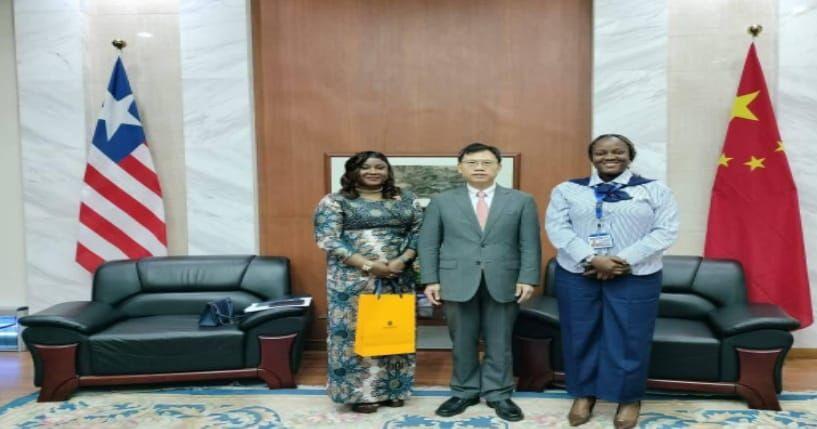
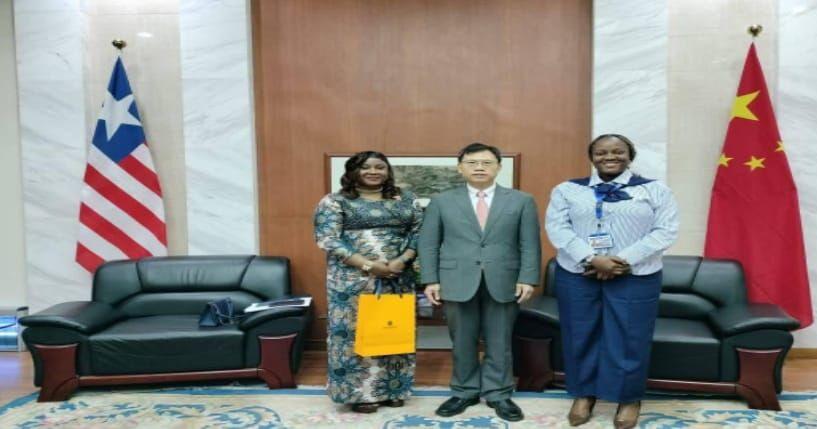
The Director General of the Liberia Intellectual Property Office (LIPO), Garmai Koboi, and the Chinese Ambassador, Yin Chengwu, have held a courtesy meeting to discuss the development and advancement of intellectual property in Liberia.
China, which has a large development footprint in Liberia, has in time past been a supportive partner to LIPO, providing technical assistance in capacity building, which has improved the Office’s human capital.
During the meeting at the Chinese Embassy in Congo Town, Hon. Koboi thanked the Government and People of China for their longstanding friendship and continued support to Liberia.
According to a LIPO statement, officials’ discussions during the meeting focused on several technical cooperation areas, including capacity-building opportunities for IP administrators and enforcement agencies, digitalization of IP systems, support for small and medium enterprises, protection of traditional knowledge and cultural expressions, as well as South-South cooperation.
The meeting, the statement added, ended with Hon. Koboi and Ambassador Yin reaffirmed their commitment to sustained engagement and exploring avenues for technical cooperation, institutional partnerships, and future collaboration frameworks aimed at strengthening intellectual property administration and fostering innovation-driven development in Liberia.
“The meeting aligns with LIPO’s broader efforts to strengthen international partnerships and advance the Government’s ARREST Agenda for Inclusive Development (AAID) Economic Transformation,” Koboi said. “Through meetings like this, Liberia aims to create an IP environment that fosters innovation, safeguards creativity, and supports sustainable economic development.”
The discussion, the statement noted, comes as LIPO is about to hold a validation workshop on December 19 for its Draft National Intellectual Property Policy Strategy (NIPPS), in collaboration with the World Intellectual Property Organization.
The workshop, which is expected to bring diverse stakeholders from education, artistic, business, legal, and government sectors, represents a critical step in fulfillment of the ARREST Agenda’s call for the development of a robust national intellectual property ecosystem.
The NIPPS is a five-year strategic framework designed to revolutionize Liberia’s IP landscape by establishing comprehensive policies, strengthening enforcement mechanisms, and creating an enabling environment for innovation and creativity. The strategy aims to align Liberia’s IP infrastructure with international standards while addressing local needs and protecting indigenous knowledge systems.
Key components of the NIPPS include modernizing IP registration processes, enhancing public awareness about intellectual property rights, establishing specialized IP tribunals, and creating incentive structures for researchers and innovators. The strategy also prioritizes building partnerships with international organizations and regional bodies to accelerate Liberia’s IP development trajectory.