On the southern edge of New Clark City, a fast-growing economic zone north of Manila, an 18-hole golf course is readying to open its fairways.
Known as The Vista Country Club, the project marks a pivotal moment for Dawon Corporation, South Korea’s largest landscaping firm, as it steps into a role it has never fully occupied before: property developer.
Originally conceived as a 27-hole golf complex, the country club will open in phases, beginning with the 18-hole course and clubhouse.
For Dawon, the move into the Philippines represents more than geographic expansion.
It signals a shift away from a business model tied largely to construction cycles toward one that combines planning, development and long-term operations.
FROM CONTRACTOR TO DEVELOPER
For decades, Dawon built its reputation, shaping what lies beneath the surface of cities, stabilizing highway slopes, restoring damaged land and designing the green spaces of large apartment complexes.
At The Vista Country Club, however, the company has overseen the project end to end, from planning and permitting to construction, and will operate it after opening, retaining exposure to operating income rather than exiting upon completion.
 The Vista Country Club (Courtesy of Dawon)
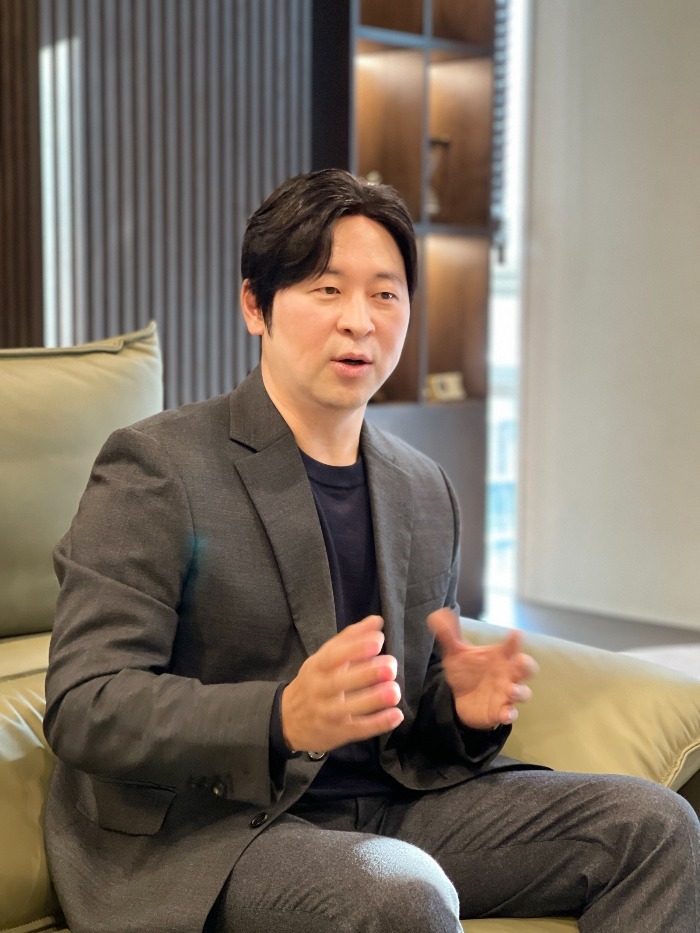
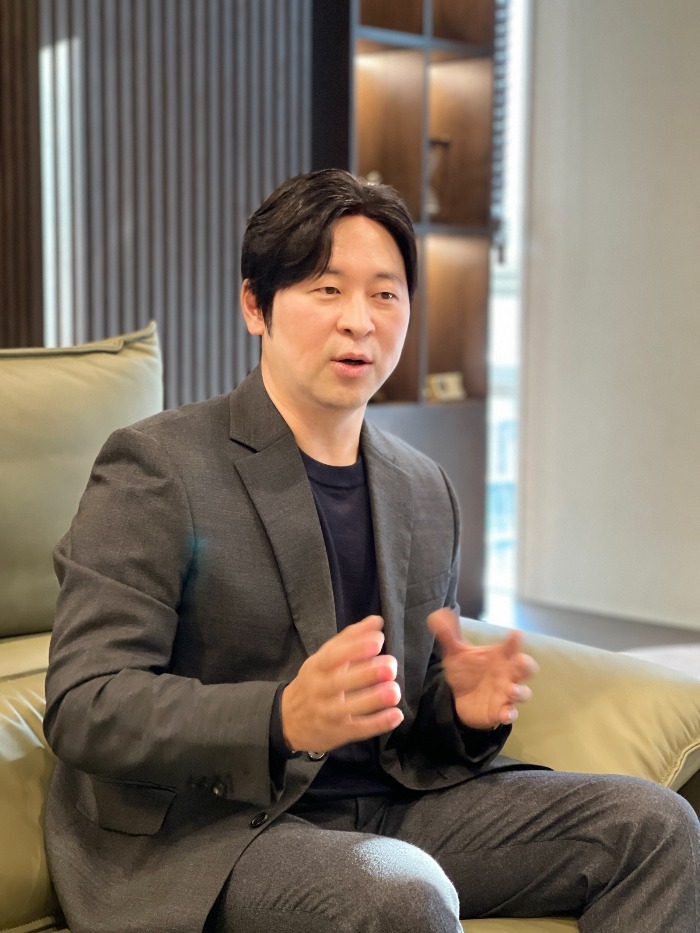
“It’s a structural shift,” said Dawon Chief Executive Kim Dae-joong, who has led the company’s strategic transition over the past decade as its second-generation leader.
The Clark area, designated by the Philippine government as a special economic zone, is famous for its clusters of golf resorts and reasonably priced green fees, emerging as a favorite destination among tourists, especially Korean golfers.
Dawon’s technical roots shaped how the project was executed.
Course design was handled in-house, drawing on decades of experience in earthworks, turf management and landscape engineering.
In a market where supply chains can be unreliable, the company established its own local landscaping materials operation, acquiring land to cultivate and manage plant resources directly.
“A golf course is where civil engineering, turf and landscaping all come together,” Kim said. “That’s where we felt we had a clear advantage.”
STAYING LONG ENOUGH TO LEARN
Dawon’s overseas expansion did not begin with The Vista Country Club.
The company first entered the Philippine market in 2018 as a landscaping subcontractor on residential developments led by POSCO E&C Co.
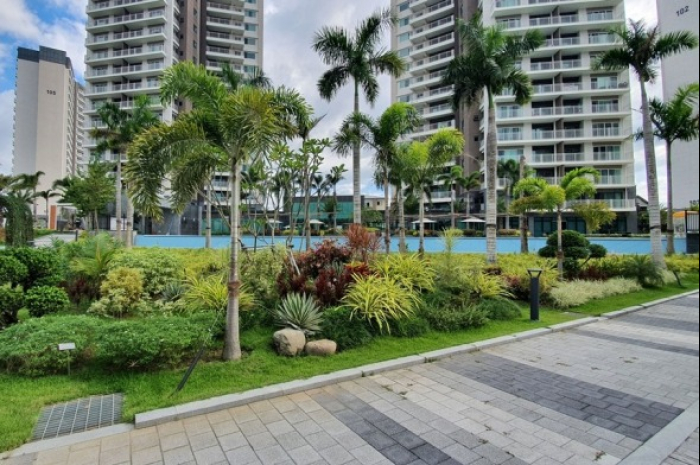 Dawon’s landscaping for The Sharp Clark Hills in Mabalacat, Pampanga in the Philippines (Courtesy of Dawon)
Since then, it has maintained a local presence for years instead of scaling up quickly, studying land ownership rules, administrative processes and the risks associated with foreign investment.
That patience has paid off, Kim said.
“Those ownership and regulatory complexities, along with foreign investment risks, tend to discourage large builders,” he said.
“But for a mid-sized company like us that can make decisions quickly, they can become opportunities.”
The Philippines has since become central to Dawon’s overseas ambitions.
In Pampanga province, the company is advancing plans for a large integrated resort combining a hotel, condominiums, pool villas and another golf course, a project expected to require up to 350 billion won ($240 million) in investment.
FROM ECOLOGICAL RESTORATION TO MARKET LEADER
 Dawon CEO Kim Dae-joong presents The Vista Country Club project
Founded in 1992 as an ecological restoration specialist focused on highway slopes and land rehabilitation, Dawon later found growth in residential landscaping as South Korea’s housing market expanded. That shift transformed the company’s scale.
Since Kim, son of founder and Chairman Kim Yong-kak, joined the firm in 2016, revenue has risen from 18 billion won to 250 billion won in 2024, as Dawon secured landscaping contracts across apartment complexes nationwide, making it the country’s top landscaping contractor by sales.
But landscaping work is closely tied to housing starts and infrastructure spending, placing it late in the construction value chain and leaving earnings vulnerable to downturns, Kim said.
To counter that volatility, Dawon began moving upstream, seeking opportunities to participate earlier in projects where it could influence design, cost structure and long-term value.
MOVING UP THE VALUE CHAIN
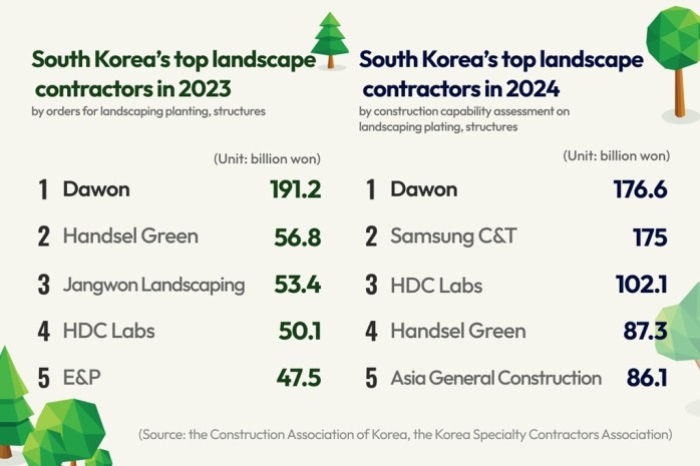 Graphics by Dongbeom Yun
The company is applying the same approach at home.
In South Chungcheong Province, Dawon has taken a 25% equity stake in a coastal tourism complex that includes a golf course and resort, partnering with financial investors such as Korea Real Estate Investment & Trust Co. (KOREIT), which holds a 50% stake.
The structure allows Dawon to combine capital participation with construction expertise, expanding its role without abandoning its core strengths.
As Dawon expands cautiously abroad and upstream at home, Kim is careful to frame the transformation as evolutionary rather than radical.
“We’re starting with projects where our construction expertise gives us a clear edge,” he said.
“Over time, we will grow into an infrastructure developer that designs projects and operations together.”