
By Dinh Nguyen, Minh Hue
Sat, January 3, 2026 | 10:14 am GMT+7
After a period of stagnation and cleansing, Ho Chi Minh City’s real estate market entered a new development cycle in 2025, with increasing affordable and social housing supply from projects in the former provinces of Binh Duong and Ba Ria-Vung Tau which were merged into the metropolis in July.

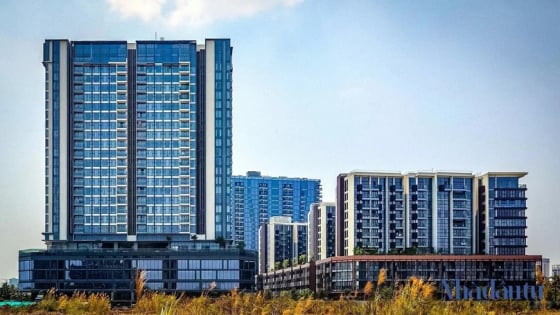
The HCMC real estate market entered a new development cycle in 2025. Photo by The Investor/Vu Pham.
According to a report by the Ho Chi Minh City Real Estate Association (HoREA), over the past five years, the city’s real estate market has faced numerous difficulties and challenges.
Legal regulations remain inconsistent and not aligned with reality, and law enforcement is yet to truly serve citizens and businesses. This issue has led to many “legal bottlenecks” in investment and construction activities, particularly for real estate projects, urban areas, commercial housing, and social housing.
Nevertheless, industrial real estate and several mega urban area projects and high-end developments by reputable corporations have emerged as “bright spots”.
The real estate market in the former HCMC hit its lowest point in Q1/2023, declining by 16.2%, but has gradually recovered since the end of Q2/2023 and continued its recovery and growth trend to date.
Increased supply, reduced imbalance after merger
In 2025, real estate groups and enterprises managed to endure the downturn and had opportunities to break through, thanks to a “revolution” in legal institutions.
Notably, the Politburo’s four key resolutions No. 57, 59, 66, and 68 have strengthened business confidence while guiding the development and completion of the legal framework to create a transparent, fair, and healthy business environment.
As a result, the city’s property market is expected to become increasingly transparent, safe, and sustainable, helping to address the long-standing imbalance favoring high-end housing and the shortage of mid-priced, affordable, and social housing.
For example, in 2020, the former HCMC recorded only 163 new units of affordable commercial housing, or only 1% of total new housing supply. From 2021 to June 2025, the market saw no affordable commercial housing at all, and from 2024 to June 2025, only high-end housing was available.
This situation has driven housing prices beyond the financial capacity of most middle- and low-income urban residents, including civil servants, public employees, members of the armed forces, workers, and migrants.
Following the merger with Binh Duong and Ba Ria-Vung Tau, the new HCMC now covers an area of approximately 6,772 square kilometers, with an official population of 14 million. In reality, the population may reach 18 million, including migrants and temporary residents.
This expansion has created new development space, setting the goal of becoming a global megacity, building an international financial center, and clearly demonstrating the characteristics of a “regional economic hub.”
At the same time, the restructured real estate market of the new city has reduced the imbalance toward high-end housing, thanks to the additional supply of mid-priced, affordable, and social housing from numerous projects in the former Binh Duong and Ba Ria-Vung Tau.
Experts and businesses believed that the recovery of HCMC’s real estate market in 2025 is the result of the combined impact of three main factors.
First, the legal framework. The synchronized implementation of the 2024 Land Law, the 2023 Housing Law, and the 2023 Law on Real Estate Business from mid-2024 has begun to take effect.
Bottlenecks related to project approvals, land valuation, and financial obligations have gradually been resolved, making the market more transparent and restoring investor confidence.

The An Phu interchange project is underway in Ho Chi Minh City. Photo courtersy of Phap luat TP. HCMC (HCMC Law) newspaper.
Second is the boost from transport infrastructure. In 2025, Metro Line No. 1 (Ben Thanh-Suoi Tien) officially commenced commercial operations, transforming the urban landscape of the eastern corridor.
At the same time, key projects such as HCMC Ring Road 3 (in its final completion stage), the An Phu interchange, and the expansion of National Highway 50 have created strong momentum for suburban areas.
Third is bank interest rates. Throughout most of 2025, mortgage interest rates remained stable and attractive, ranging from 6-8% per year for preferential loan packages, encouraging homebuyers to more confidently access housing credit.
Apartments dominate market
While the period from 2018 to 2022 was the golden age of land plots and resort real estate, 2025 witnessed a strong rise of apartments. This segment was regarded as the “bright star” of 2025.
With rapid urbanization and a continuous influx of migrants into HCMC, housing demand remained extremely high. Projects with reasonable prices, comprehensive amenities, and reliable construction progress achieved absorption rates of up to 90% within the first month of launch.

Customers explore an apartment project in Ho Chi Minh City. Photo by The Investor/Vu Pham.
Real estate prices in 2015 established a new, higher benchmark compared to previous periods, driven by rising input costs such as land-use fees under the new price framework, construction materials, and labor.
Specifically, in the luxury segment (former District 1 and Thu Thiem), prices ranged from VND250-550 million ($20,912) per square meter. Branded residences continued to maintain record prices due to limited supply.
In the high-end segment (former District 7, Thao Dien, Thanh My Loi), prices ranged from VND120-180 million ($6,844) per sqm. The mid-range segment (former Thu Duc city, District 8, and Nha Be district) was the most dynamic last year, with prices from VND65-95 million ($3,612).
Notably, the affordable segment reached VND45-60 million ($2,281). However, it is now very difficult to find new apartments priced below VND40 million in the inner city. More affordable options are mainly available in the former provinces of Binh Duong and Ba Ria-Vung Tau.
Investment “hotspots”
According to HoREA, in 2025, HCMC’s real estate market attracted significant capital flows from investors in northern Vietnam. While the city center was still considered to have growth potential, several suburban areas such as Can Gio and Binh Duong also emerged as attractive destinations.
Historically, before 2022, property prices in HCMC were higher than in Hanoi. However, since 2023, Hanoi’s real estate prices have surpassed those of HCMC. Therefore, in the coming period, as HCMC completes its infrastructure development, its growth potential is expected to be substantial.
Moreover, following the merger, HCMC has become a megacity contributing nearly 24% of national GDP – almost one-quarter of the country’s total. With this scale, the city’s real estate market is forecast to experience strong growth driven by infrastructure and social development.
Over the next five years, as infrastructure investment becomes more synchronized, property prices in the city are expected to undergo significant changes, creating major opportunities for investors.

The Vinhomes Green Paradise developed by Vingroup in Can Gio, Ho Chi Minh City. Photo by The Investor/Vu Pham.
Regarding suburban land plots (in areas such as Binh Chanh, Cu Chi, and Can Gio), after a prolonged slowdown, legally certified land plots have seen a modest price increase, ranging from VND35-70 million ($2,662) per sqm depending on location and surrounding infrastructure.
In particular, Can Gio has experienced rapid land price increases since the commencement of the Can Gio sea encroachment tourism-urban area project by Vingroup, accompanied by signs of land hoarding in anticipation of further price hikes.
The association concluded that HCMC’s real estate market moved past its “bottom” in 2025 and is on a solid recovery path. With synchronized infrastructure and strong genuine housing demand, the market is not only an investment channel but also a key driver of the city’s economic development.
However, challenges remain, including persistently high prices, segment imbalances, interest rate pressures, and inflation risks.