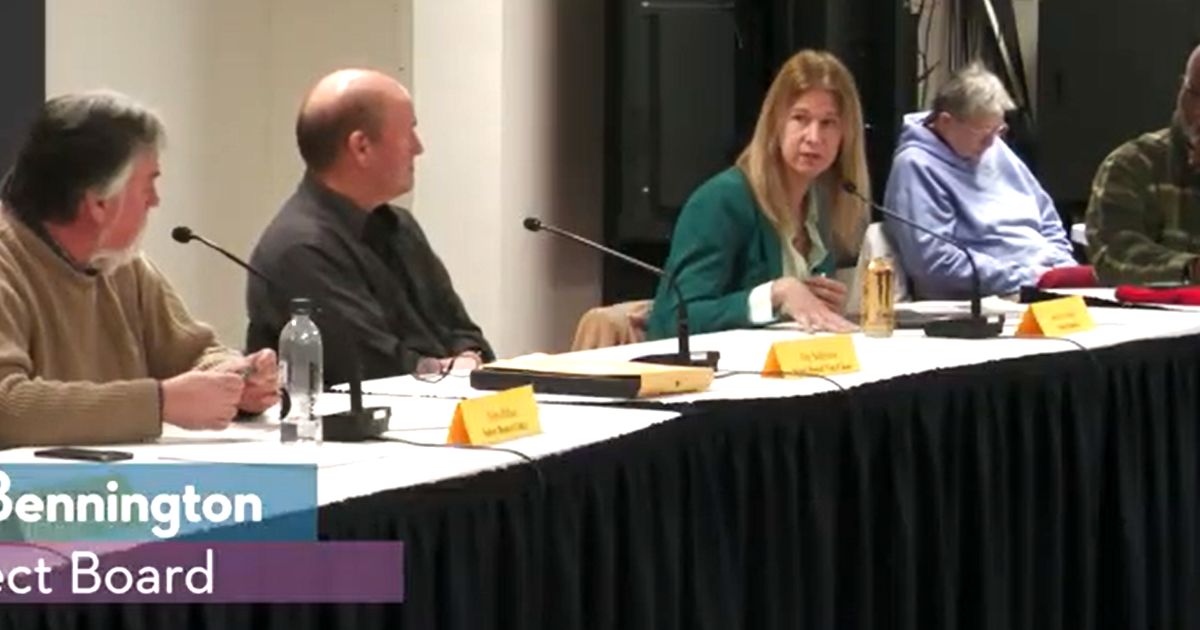
BENNINGTON — Aiming for a significant reset of the town’s efforts to promote housing and commercial development, the Select Board has created a standing subcommittee to work closely with town staff and community partners toward those goals.
The three-person board subcommittee members will meet with private developers with ideas, lenders and others involved in development, and also work closely with town staff to come up with recommendations to present to the full Select Board.
Grew from discussions
Chair Tom Haley said board members Clark Adams, who is the subcommittee chairman, and Jackie Matts brought the initial concept to him last year, based on their discussions. Haley then appointed an informal study committee, adding board member Jim Sullivan.
In addition, the board this week voted to rename the Community Development Department as the Department of Housing, Community and Economic Development, which is seen as the key entity working with the subcommittee.
Community Development Director Shannon Barsotti gave a presentation to the Select Board on the proposal.
She said the purpose of the subcommittee is “to act as an information-gathering and strategic planning task force,” which then reports back to the select board.
Barsotti said the committee can also invite guests from partner organizations, such as the Better Bennington Corporation, the Southwestern Vermont Chamber of Commerce, local banks, and developers to meetings to discuss plans or development projects under consideration.
Haley and Town Manager Dan Monks said the size of the committee – less than a quorum of the Select Board – allows the group to meet privately with business people without divulging their proposals until they are ready to make those public.
Adams said he wanted to thank Haley and the town manager for approving of the committee. He also highlighted one of the initial goals of the group, which is to assist private developers in creating new housing.
“As everyone is aware housing is a critical issue, not just in our town,” Adams said. “It’s also a keystone for development. Businesses aren’t going to come to town if they don’t have places for their employees to live.”
He added, “Our [property] grand list isn’t going to grow if we don’t bring more businesses and people to town. And our quality of life is going to suffer.”
The overall plan, Adams said, “is to come up with a pathway to expand the availability of housing … We’re not going into the housing business. We want to make it as easy as possible for people who want to expand the housing footprint in this town to do so. We want to do whatever we can to reduce obstructions and accelerate the process.”
Adams said he believes “that the more housing is available, the lower the prices are going to be,” and that lowering housing costs and expanding the tax base will lower the costs for landlords and can therefore result in lower rents for tenants.
Comments, ideas sought
“We are available,” Adams said, adding, “If there are people in town who have ideas or concerns about housing, development or even the general economic development in Bennington, please don’t hesitate to come see us or give us a call.”
Questions, ideas and concerns also can be directed to town staff, he said, including Barsotti’s department and newly hired town Planning Director David Conwill.
In her presentation, Barsotti mentioned a recent column that appeared in the Bennington Banner by the Vermont Chamber of Commerce on the challenges the small state faces in economic development – an aging population, slow job growth and a lack of affordable housing.
On a positive note, she said, “Vermont ranks near the top for quality of life and safety … So those are things that we want to lean into.”
She added, “When we look at the committee’s [first] task, it is really to identify concrete steps for economic action in the coming year.”
Long-term goals, she said, are to strengthen the local economy, grow the tax base, attract private investment, and improve quality of life, such as through creation of recreation facilities and making neighborhoods and the downtown more attractive.
The effort, she said, will focus on leveraging outside funding through grants and private investment, prioritizing development impacts and the feasibility of proposals, measuring the outcomes and engaging the Bennington community in the process.
‘);]]>
‘Reduce barriers’
“We also want to do as much as we can to reduce regulatory barriers to private development,” Barsotti said. “And then we want to measure what matters: tax base growth, population growth, wage and jobs growth, number of housing units added, and the downtown vacancy rates.”
Goals include building partnerships with developers, financial institutions and philanthropic organizations; pursuing state and federal grants and utilizing state or federal programs, such as to develop housing, and using tax credits strategically, including historic and new market credits.
“And then we want to measure what matters,” she said. “Tax base growth, population growth, wage and jobs growth, number of housing units added and the downtown vacancy rates.”
They have had a few meetings, she said, and “looked at the current projects, how to support them,” and at areas such as “housing and workforce development, downtown vibrancy, quality of life initiatives, like the skatepark and pathways, regional collaboration and state-level regulatory reform. … Those are kind of the big topics that we started with.”
“When we look at the committee’s task,” she said, “it is really to identify concrete steps for economic action in the coming year.”
That would include creating “an inventory of residential and commercial development in or near downtown. Identifying all of our spaces downtown, what they are being used for, which are vacant, and what are some opportunities that we can come up with?”
The committee also would “really target some of those vacant properties downtown, encourage beautification efforts, partner with BBC,” she said.
Ways to invest more in downtown will be considered, along with ways to increase the capitalization of the town’s revolving loan fund for small biz development.
A standing committee
After the presentation, board member Ed Woods asked, “Does that committee now exist permanently as an offshoot of this board? Because it is necessary, in my opinion … This thing needs to be endorsed and become a part of the regular work that we do.”
Sullivan said, “Shannon has laid out what a municipality can do in providing the environment that makes the community a welcoming place for people and for businesses, and to find the missing pieces and the gaps that we can help fill in.”
He added, “So we thought it would make sense to begin formally referring to [the Community Development Department] as the Department of Housing, Community and Economic Development.”
The board decided to rename the department on a 6-1 vote, with Nancy White opposed.
White had raised concerns about the proposal, saying at one point, “I really wish I would hear something about trying to help Vermonters to stay. I know there is a big rush to want to get new people to come here, but the people who’ve been paying the budgets and the bonds, it’s like there’s a big push – we have to get them out, to get all the new people to come in.”
Monks responded, “I want to take exception to the comment that we are trying to push Vermonters out.”
The manager added, “I think the opposite is true, that we want to reduce that tax burden for the folks that already live here, not increase it. And the only way we do that is to grow our grand list to increase the vitality of this town.”
He said that, in one case, if the luxury resort planned for the former Southern Vermont College campus is completed, “that will be the largest increase to our grand list, ever, and that will decrease the tax bill for people who live here, in this town.”
Barsotti noted a recent surge in development momentum in Bennington that could be built upon. During 2025, she said, “over $17 million was invested in our downtown area, and of that $11.5 million was private investment. … That’s a big number for Bennington, and there is going to be more, much more, next year.”
During discussion on how to codify the subcommittee as a permanent committee, Matts recommended tabling that process, saying, “It seems there are questions about that that needs more discussion.”
She recommend asking Sullivan, Monks and other staff to come up with specific ideas on how the committee should be formed, including the rotation of committee terms and similar details.
Monks said he believes they can come up with recommendations on rules and procedures for a permanent committee by the next board meeting.