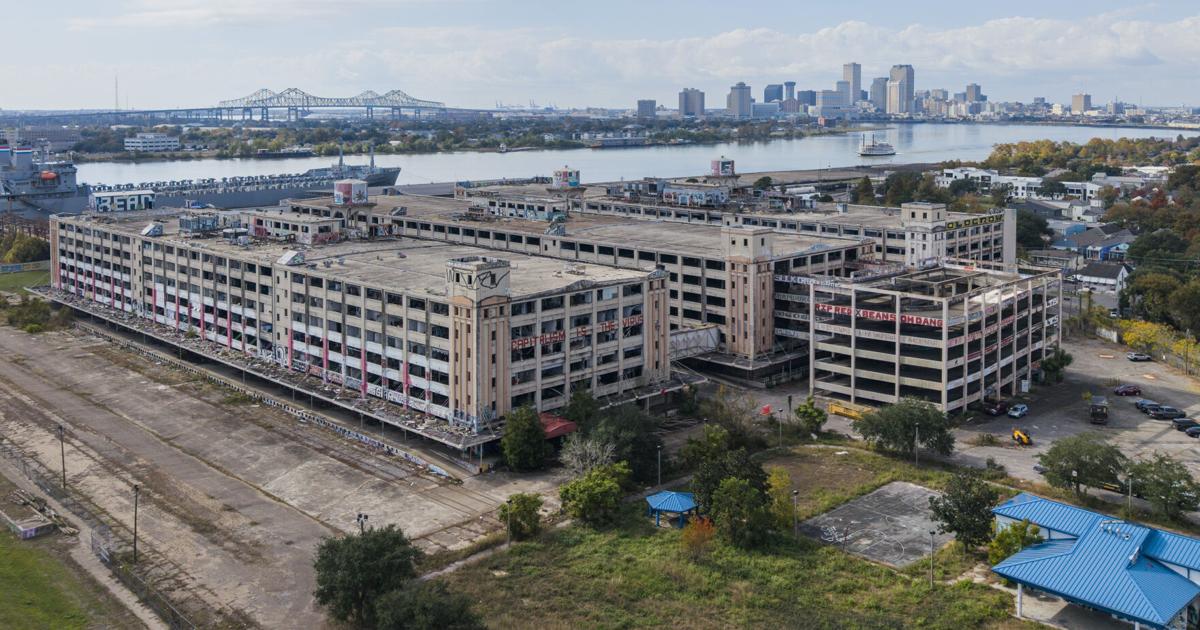
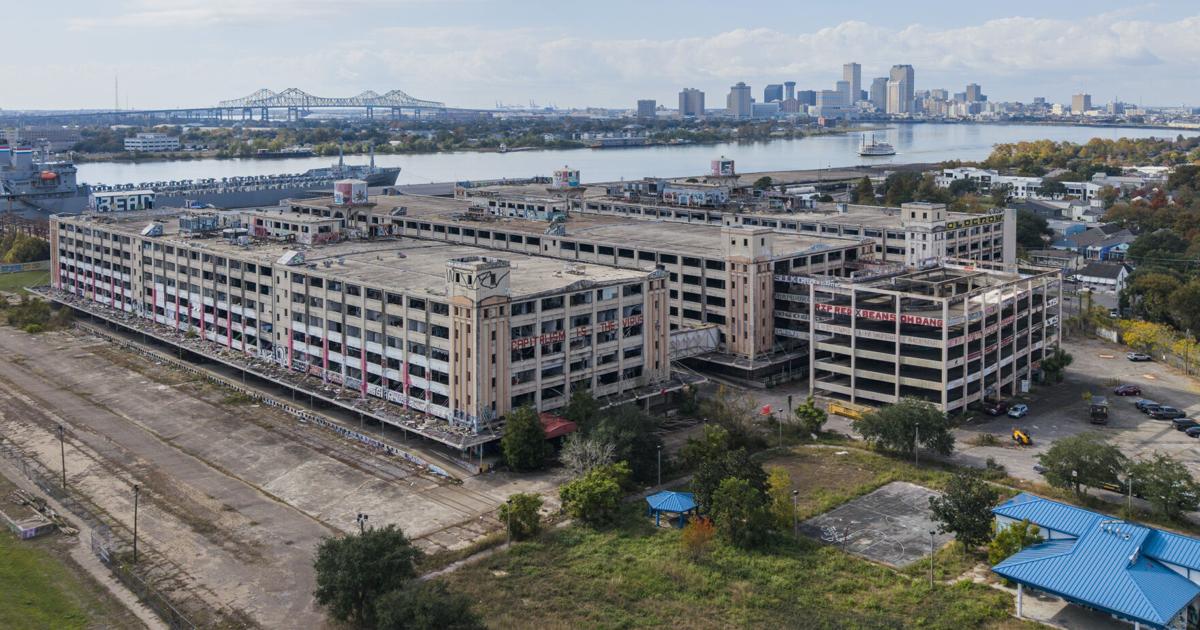
After more than 15 years of false starts and neighborhood frustration, the hulking former Naval Support Activity complex in Bywater is finally poised to transform from a deteriorating eyesore into a major affordable housing and technology hub.
Construction on the first phase of the redevelopment — a $166 million project known as NSA East Apartments — is expected to begin in late January now that financing has been secured, according to Brian Gibbs, the New Orleans-based developer who is leading the project. A formal groundbreaking is planned for the end of next month.
Once underway, the project will mark one of the most complex and ambitious rehabilitation efforts in New Orleans in years, converting a long-blighted military property overlooking the Mississippi River into 294 housing units for roughly 800 residents, along with 37,000 square feet of retail space.
Former Navy base photographed in the Bywater neighborhood of New Orleans, Friday, Dec. 12, 2025. (Photo by Sophia Germer, The Times-Picayune)
STAFF PHOTO BY SOPHIA GERMER
The first phase of the project also includes a $50 million new technology startup incubator complex, and Gibbs has plans for a $100 million innovation center and nearby green space development in the second phase.
“We will not have to ask people to suspend disbelief anymore; they are finally going to see contractors at work,” said Gibbs, who took over the project last summer after its original developer, Joe Jaeger, was killed in a car accident. “We hope that will buy us some credibility with the neighborhood, with renters, potential businesses for the retail space — all the stakeholders.”
For Gibbs and city officials, the closing of the financing package has turned into a test case for whether New Orleans can still assemble the dense web of public and private funding that’s needed to redevelop large-scale obsolete or publicly owned sites — particularly those including affordable housing.
The milestone comes as Gibbs, who had little experience in affordable housing before NSA, has found himself a partner in several pubic-private projects that together would provide affordable or workforce housing for thousands of residents.
It is an opportune time: Mayor-elect Helena Moreno has put plans to partner with the private sector on New Orleans’ vast undeveloped real estate portfolio at the center of her economic development policy.
A site frozen in time
Located at the intersection of Dauphine Street and Poland Avenue, the 20-acre former Navy complex has a layered history stretching back more than a century, having served various military functions before the Navy officially closed the facility in 2009.
The federal government transferred the property to the city in 2013, and expectations were high that its riverfront location would make it a catalyst for Bywater’s continued revival.
But little progress was made. And over time, the massive buildings became graffiti-strewn and increasingly derelict, attracting squatters and criminal activity that spilled into surrounding streets.
Rubble from the former concrete fence around the derelict Navy base lies on the ground in the Bywater neighborhood of New Orleans, Friday, Dec. 12, 2025. (Photo by Sophia Germer, The Times-Picayune)
STAFF PHOTO BY SOPHIA GERMER
Neighbors complained as the site — like the Plaza Tower, Lindy Boggs Medical Center, Charity Hospital and other New Orleans eyesores — became synonymous with neglect.
“We’ve been waiting a very long time for something to happen,” said John Guarnieri, president of the Bywater Neighborhood Association, who said neighbors were forced to watch it deteriorate into a crime hub, where thieves would chop up stolen bikes and break down stolen metal with welding torches.
Jaeger, a real estate developer who was instrumental in reviving the Warehouse District in the 1990s, initially secured a long-term lease for the site in 2017. At the time, the plan envisioned luxury, market-rate apartments capitalizing on the property’s river views and proximity to downtown.
But financing proved elusive.
A vision reshaped
The sheer scale of the property, its historic designation, environmental issues, and the economics of renovating aging military buildings made a purely market-rate approach unworkable. Over time, the project, which in total has a cost of $300 million, was restructured around affordable housing. It now relies on a complicated mix of tax credits and other federal, state and local subsidies.
Gibbs, who founded Brian Gibbs Development in 1997, contrasts the NSA East Apartments with other simpler projects he has worked on, including the acclaimed conversion of the historic Alden Mills knitting factory at 511 Marigny Street into 47 luxury apartments and the Paladar 511 restaurant.
That project, developed in partnership with building owner Julian Doerr Mutter of Doerr Furniture, largely involved lining up historic tax credits and conventional financing.
NSA East, by contrast, required what Gibbs described during an interview at his office at the top of the Regions Bank building as “institutional choreography.”
To illustrate the point, he pulled out a dense organizational chart that maps the federal, state and local agencies involved, alongside private-sector specialists needed to convert grants and tax credits into construction capital.
Private lenders then had to step in to bridge timing gaps and finance everything from fixes to roads and plumbing, along with professional services from lawyers and accountants.
“It became very clear that there was no other way to make this work,” Gibbs said.
Former Navy base seen across the Mississippi River from Federal City in New Orleans, Friday, Dec. 12, 2025. (Photo by Sophia Germer, The Times-Picayune)
STAFF PHOTO BY SOPHIA GERMER
In the spring, Gibbs struck a deal with Lincoln Avenue Communities, a national affordable housing developer and manager with the requisite affordable housing expertise, to come in as a 50-50 partner and assume leadership of the project once financing was completed.
Even then, new hurdles emerged.
At one point, federal housing officials demanded that something be done about the third derelict building on the site before tenants could move into the first phase.
“They said it couldn’t be left looking like something from ‘Escape from New York,’” Gibbs said, referencing John Carpenter’s 1981 dystopian urban film.
That requirement prompted City Council members Freddie King, whose district includes the site, and Lesli Harris, a longtime advocate for affordable housing, to push for additional city funding to stabilize and remediate the structure.
Late in the process, Lincoln Avenue also opted to relocate the pool and cabana area to the rooftop to fully realize Jaeger’s vision of “affordable luxury.” That decision triggered a last-minute dash to revise architectural plans and secure updated city permits.
Deep tech arrives in Bywater
Adding to the project’s complexity is a $50 million facility for Brooklyn-based Newlab, an incubator focused on engineering and “deep technology.” The Newlab building, which will be constructed as part of the first phase of the project, is being funded by a coalition that includes the state, the city, Shell Oil, LSU and Greater New Orleans, Inc.
The incubator will focus on areas such as energy efficiency, carbon management and port infrastructure — fields closely tied to Louisiana’s industrial base.
Gibbs said he hopes Newlab’s presence will help the project’s second phase get off the ground. The plan is to channel the rental income he will get from the facility to help finance the $100 million conversion of a third building into a center for the kinds of companies Newlab is designed to support.
“That’s where this starts to become a real ecosystem,” he said.
Green space and a larger vision
Gibbs has also begun preliminary discussions with the Army Corps of Engineers and the Audubon Nature Institute about improving the Corps-owned green space across from the site, an informal area known as “The End of the World,” where the Industrial Canal meets the Mississippi River.
The idea would be to landscape and enhance that space and link it via a green corridor to Crescent Park, just a few hundred yards upriver on Chartres Street. The Audubon Institute would manage it and its CEO, Michael Sawaya, said he backs the idea if the costs are covered.
The cost, Gibbs said, would be “a rounding error” on the price tag for the project’s second phase, but it could be transformative. It would also align with civic leaders’ desire for a continuous, publicly accessible riverfront from the Industrial Canal to the emerging River District.
“It would completely change how people experience this area,” he said. “It turns it into a destination.”
A lesson in what it takes
For Jeff Schwartz, who heads the city’s Office of Economic Development, the NSA East Apartments illustrates both what is possible — and why so many major sites in New Orleans remain stalled.
Schwartz has been involved with the project since its earliest days and participated in weekly progress meetings for years. He is also working with Gibbs and partners on other large-scale efforts, including the multibillion-dollar River District.
Gibbs is also a minority partner with Lincoln Avenue on a proposal to convert the long-vacant Plaza Tower into 325 affordable housing units for elderly residents.
Schwartz points to those projects alongside others, like Lindy Boggs and the former Six Flags site in New Orleans East, and sees a common thread.
“Yes, the city owns a lot of vacant and blighted property,” Schwartz said, “But none of them are going to be like what Brian did at 511 Marigny. Most of the deals are going to be hairy, complicated, messy projects where you have to get great partners to the table and create space for good things to happen — and they’re going to take years.”