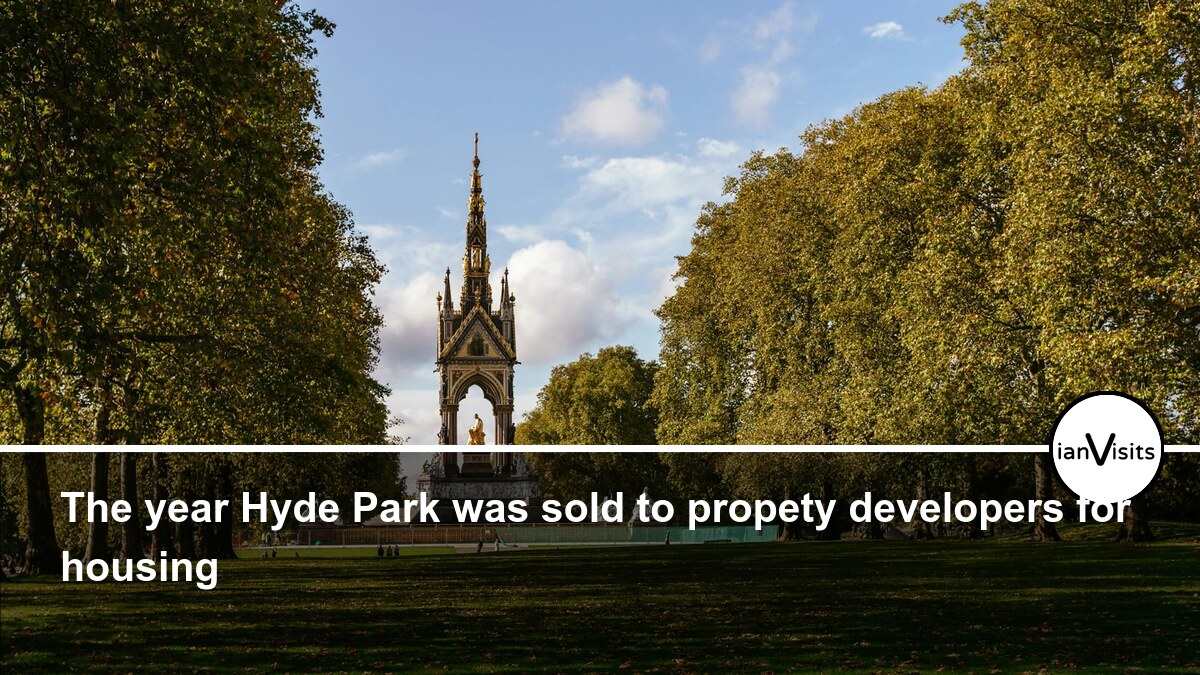

Did you know that Hyde Park shouldn’t exist as a large park, because it was once sold for development into housing plots?

Had that been carried out, the Serpentine wouldn’t exist, Kensington Palace would be surrounded by houses, and the Winter Wonderland would have its funfair somewhere else.
To explain, it helps to know how Hyde Park (originally Hide Park) came to be.
Hyde Park owes its origins to the Dissolution of the Monasteries, when King Henry VIII seized open land on the outskirts of London owned by Westminster Abbey. He enclosed it as a deer park, and it wasn’t until King James I that suitable ordinary folk were allowed inside for a walk around.
Eventually, King Charles I fully opened the park in 1637, allowing everyone to enjoy it.
The irony is that it was the King’s execution that led to the park being sold to property developers in the first place.
After the regicide of King Charles I, the newly created English Council of State started rebuilding the war-torn country, and needed money to do so. And fortunately for them, while the government was broke, the City of London’s merchants and traders were not (and been on Parliament’s side in the civil wars), and they were keen to snap up a few bargains while they could.
So the government began selling off Crown lands, but the law permitting the sales has expressly excluded Hyde Park. Until that is, 1st December 1652, when a special resolution was passed declaring that “Hyde Park be sold for ready money.”
It was split into five divisions: Kensington, Gravel Pit, Banqueting House, Old Lodge and Middle.
Richard Wilcox paid £4,144 for the Gravel-pit division.
The Kensington division was bought by the City of London merchant, John Tracy, for £3,906.
The Middle, Banqueting, and Old Lodge Divisions were purchased by Anthony Deane of St. Martin’s-in-the-Fields, for £9,020. However, as he borrowed heavily to buy the land, he later sold a chunk to John Tracy and leased the rest.
Of this sum, £4,899, 10s. was realised for the timber, so evidently the Park must have been thickly wooded at that time. There were also sold Tyburn Meadow and the enclosed meadow-land used for the deer, which were numerous. These animals brought in the sum of £765, 6s. 2d, with the money being devoted to the Navy.
Having borrowed heavily to buy Hyde Park, Anthony Deane quickly needed to start earning an income from it, so he began charging an entry fee to visit the park.
Which went down about as well as you can imagine.
In his diary, John Evelyn wrote on 11th April 1653, “I went to take the air in Hyde Park, when every coach was made to pay a shilling, and horse sixpence, by the sordid fellow who had purchased it of the State, as they were called”
There are also suggestions that the developers felled many of the largest trees, either for sale or as land clearance, but it’s unclear.
Certainly, it was intended that the land would be developed eventually.
An advert in the Marcurius Politicus of 13th-20th May 1658 stated “This is to give notice that if any persons have a minde to employ their money in Building, they may have Four Acres of Ground, and a convenient place to build on in Hide Park”
But of course, it was not to be.
Not too many years passed with Oliver Cromwell behaving as if he were King in all but name, and ensuring his son would inherit the Crown Lord Protectorship after he died – the Parliamentarians had enough.
They decided that they were going to be ruled by someone behaving like a King, then they might as well have a King, and promptly deposed Richard Cromwell and invited Charles II to reclaim the throne.
Following the restoration of the monarchy in 1660, Hyde Park once again became part of the Crown lands. However, it’s unknown whether the land was confiscated under the provisions of the Act of Abjuration, which abolished all laws passed during the interregnum, or whether the (fairly poor) King Charles II paid for it.
It’s suggested that the Law Courts annulled the sale, although John Tracy was able to argue for partial compensation by retaining two of the Knightsbridge houses he had built on Hyde Park Corner.
Considering that anyone too closely associated with the Commonwealth could face the ire of the Crown, and maybe the Axe as well, it was sometimes politically sensible to simply hand lands back and sneak away, hoping no one asks too many questions about how you came to own it in the first place.
Now that the King owned Hyde Park again, he scrapped the entry charge to go inside for a walk – which was always going to be a popular decision – and later built a high wall around it to enclose more deer. The wall was finally replaced with iron railings in 1828, when the grand entrance screen at Hyde Park Corner was also erected.
—
Of course, we’re left with a what-if situation. What if the Cromwell family hadn’t been so regal in behaviour and maybe reformed government so that powers were devolved to Parliament instead of retained by the Lord Protector?
The monarchy might not have been restored, and what is today Hyde Park would buried under thousands of homes instead.
And I’d have a few dozen more alleys to write about.