
HONG KONG – Chinese property developers are no longer required to report monthly data related to the country’s “three red lines” policy, local media said on Jan 29, marking an apparent end to rules that triggered a major debt crisis that continues to this day.
Shares in several real estate developers spiked on the news, with China Aoyuan soaring 34.3 per cent. Sunac China Holdings surged 29.1 per cent while Country Garden Holdings climbed 16.4 per cent.
China Real Estate Business, a media outlet managed by the Ministry of Housing and Urban-Rural Development, reported that the “three red lines” policy has basically ended.
A spokesperson for the ministry could not immediately be reached for comment.
The “three red lines” refer to caps on debt-to-cash, debt-to-assets and debt-to-equity ratios that the Chinese authorities imposed in 2020 on developers for obtaining new lending.
The idea was to rein in the sector’s appetite for unbridled borrowing, but it backfired spectacularly by causing a liquidity crunch from mid-2021, with many developers since defaulting on their debt.
For example, China Evergrande, once one of the country’s biggest developers, is now in liquidation, while Country Garden recently completed a restructuring of its offshore debt.
China Vanke, another embattled top-ranked developer, recently gained creditor approval to defer some repayments, staving off a potential default.
Mr Liu Shui, an analyst at China Index Holdings – a real estate analytical firm – said the rules no longer served their intended purpose given changes in the industry.
Developers have “abandoned the debt-driven expansion model and no longer prioritise scale above all else, instead focusing on high-quality development”, he said, adding that aggressive companies in the sector have already defaulted.
That said, Mr Liu warned that dropping the policy is unlikely to ease the property sector’s funding challenges, which are closely tied to market conditions.
“With the property market still in deep adjustment and financial institutions remaining risk-averse, significant changes in financing conditions are unlikely in the near term,” he said.
The CSI 300 Real Estate Index in China climbed 5 per cent on Jan 29 to its highest level in two months, while the Hang Seng Mainland Properties Index rallied 4.8 per cent. The broader market was flat.
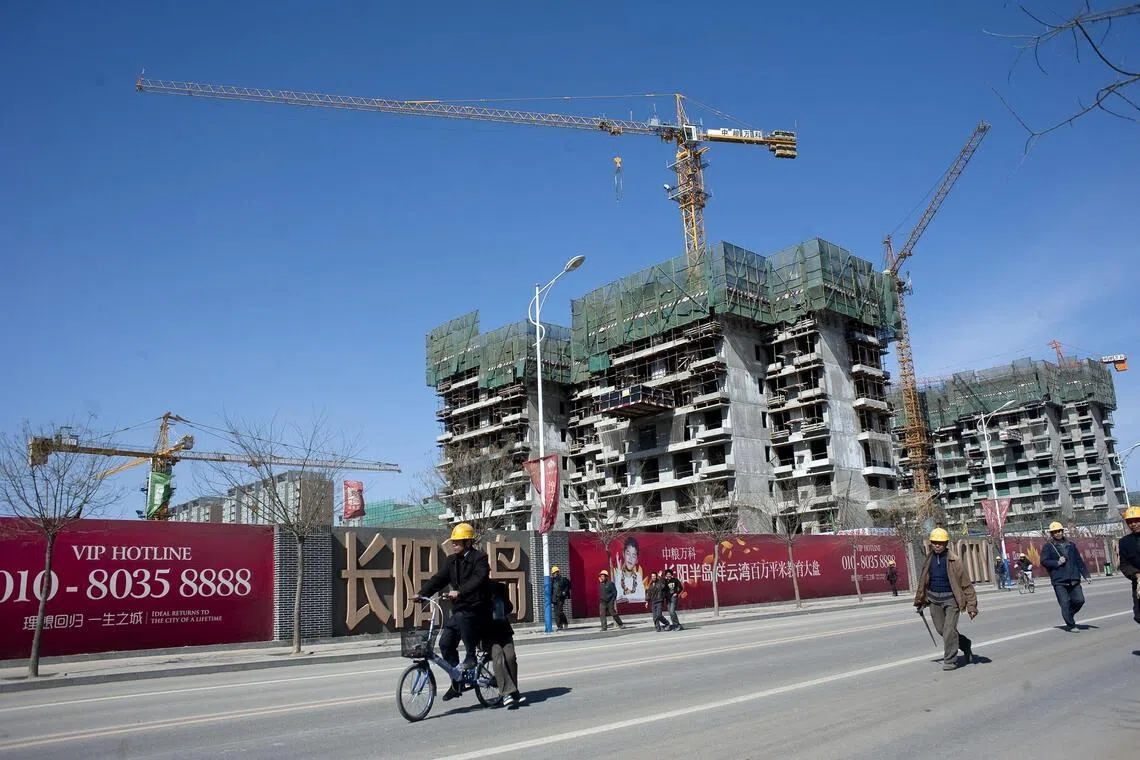
The property downturn hit the Chinese economy hard, with home buyer and investor confidence slumping as swathes of apartments went unfinished.
An official Communist Party journal said on Jan 1 that the country’s property sector remained a pillar of the economy and had significant room for transformation.
The sector was “undergoing a profound adjustment”, the Qiushi article said, and it called for “strong policy actions” to stabilise expectations.
The Chinese authorities have, over the years, taken a raft of measures aimed at supporting the property market, but
new home prices extended declines in December,
underscoring persistent strains in the sector. REUTERS