KEARNEYSVILLE, W.Va. –Recovery Village has been open in Kearneysville for less than a year, but according to Director Theresa Jenkins, they are doing great things.
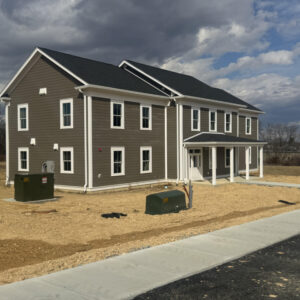 Recovery Village unit (Semper Liberi photo)
“We’re a first in the nation, progressive housing model,” Jenkins says. “Those who have completed treatment and those who have been incarcerated and are now reintegrating into the society that they left.”
The facility currently has housing for men and women.
Jenkins says they are getting ready for Phase Two, which will be 20 one- bed room apartments and later three and four bedroom townhomes “to start integrating families back in.”
Recently, Recovery Village’s parent organization Semper Liberi received three grants through the West Virginia First Foundation.
“We were very lucky that the West Virginia First Foundation did give us three grants this year. It gave us the seed money to move forward with the planning and the architectural work that we’ll need for phase two,” she says.
“Also a grant for the justice involved that we can keep helping them get skills and training.” The third grant is “Rise Up,” which she explains as “another one that helps with the work we’re already doing to keep moving forward.”
Nathan Mondragon is an outreach coordinator who is in long-term recovery himself. “I bring a lot of passion to this because I care. I want these guys to get to be a dad again, you know, to be a brother again, a son, a mother, a sister, a cousin. You know, we just have to nurture that. We have to guide them. That’s why it’s so important to meet them right where they’re at because it was done for me.”
Both were guests recently on Panhandle Live.
In April, Program Manager Dr. Jonathan Hartiens was on Panhandle Live, where he talked about Recovery Village and its possible expansion.
“This has been an evolution in the making. We started about four years ago in about 2021. I had opened up the Mountaineer Recovery Center, which is out in Kearneysville also, and we opened that in 2019. And then we noticed that several people that left treatment who were motivated, they graduated with good skills, they were excited about their sobriety,” he said. But then, “They didn’t really have many choices on where to go and they went back to the same environments that they came from around the same people they had been around before or they did not really have good work opportunities available to keep them busy and to build momentum.”
“We began to realize with so many people returning back to treatment after leaving us once before that, we needed to have an opportunity for them to go to some place that was safe, affordable and also provided some additional supportive resources.”
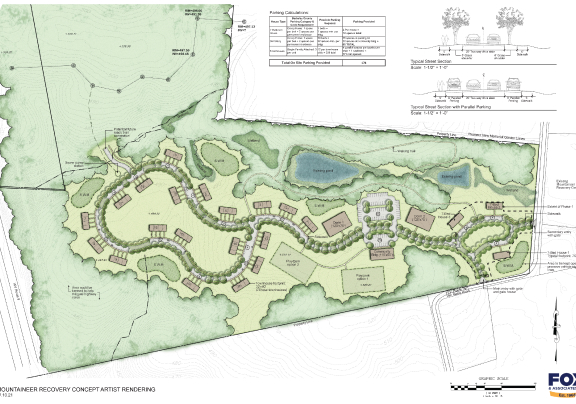
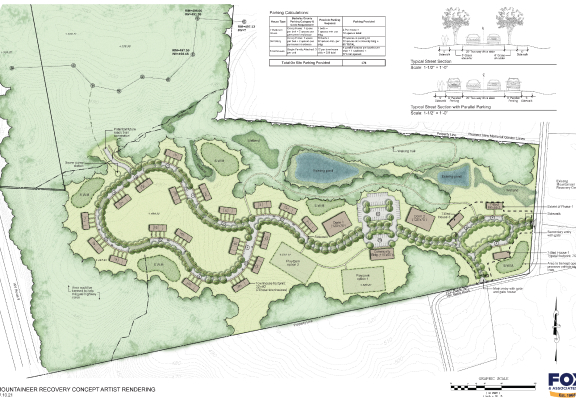
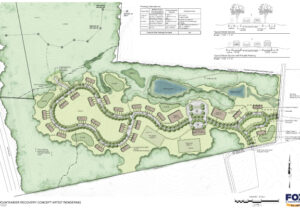 Recovery Village Rendering (Semper Liberi photo)
He applied for a grant with DHHR to open up three sobriety houses or recovery residences as they’re commonly called.
“About that same time we had someone who had 72 acres right there behind the Recovery Center that was willing to sell us their land for that project and we weren’t anticipating that initially, but that became a beautiful opportunity with the the acreage there.”
“It goes all the way to the bike path,” Hartiens said. “It runs up against Route 9. It’s got ponds on it, wooded areas, log and trails. So it just became a beautiful place to create a neighborhood we thought about. And one of the things that my wife and I talked about was when we looked at places to live here. In Berkeley County, we noticed that most of the time we looked for places that reflected the same values as us.”
He explained, “When we moved here, we had young kids, so we looked for a family-friendly neighborhood. Now that we’re getting older and we’re downsizing, we’re thinking about what’s more of a retirement community maybe to live in.”
“And we thought a recovery village would be a place for people to live, share the same values of sobriety. And so that’s the the idea of the whole village being a neighborhood.”
The goal, he says, is “ultimately to build 200 houses in there for people to live where the shared value is sobriety”.
“We see the village now to be somewhat like a college campus with progressive housing. So you, the first phase, is for recovery residences where it’s more congregate living,” according to Hartiens who likens it to being a freshman in college, “and you live in a freshman dorm and there’s a little bit more rules and structure, a little bit more accountability, a few less freedoms than say a senior in college.”
As the residents in the first phase live there for 6 to 8 months and show good progress, “Then the next phase that we’re going to be looking to build is two-bedroom apartments that they can move into with a spouse or children.”
Phase three and four will be three-bedroom townhomes where, according to Hartiens, the residents “could live indefinitely.”
“The idea (would be) that those moving into the townhomes would be able to mentor those who are just coming into the recovery residences. So we’re seeing this as a full cycle of those who can start out at a lower level of housing with a little bit more restrictions and accountability and then as they progress move to greater autonomy, but also mentoring those who are just coming in.”
Hartiens said they had been able to partner with outside agencies. “The US Department of Agriculture has been supportive. They’ve provided some grant funds for us to purchase vans as part of a Rural Economic Development Fund to get people to work.”
“So not only do we provide the housing there, we transport members on a daily basis to their employment,” Hartiens explained, adding that transportation has historically been a big barrier for some in recovery. “They get a DUI, they lose their license and then they can’t get back and forth reliably to work.”
“We’re providing the transportation daily to work. We have a number of employers that we partner with,” Hartiens said. “Large employers like Procter and Gamble and Macy’s, but also small employers who need more specific niche skillsets.”
There is a monetary cost for living on the property.
“We we want to make it affordable,” Hartiens said. “So it’s, it’s $200 a week for those who are just coming in.” Hartiens explained the weekly rent makes it easier for residents to budget around weekly expenses. They work with the residents on money management. “It’s 200 dollars a week that covers all their utilities, Internet, water, their stay there and as well as the transportation. So it’s roughly $800 a month when we move into the apartments.” Hartiens is hoping to keep the fee at a flat rate.
“So again, it’ll be $800 a month” for those coming in to Phase 1. “And for those who might move into the townhomes at phases three and four, then that’ll be probably budget around $1,200 a month, which is still a good bit less than what a move-in apartment is for most people here, so it gives people a place to have affordable housing and further establish their recovery.”
“Accountability is really important. We we teach all our residents. There is no recovery with accountability. And I mean, the reality is, is that we have accountability built into our lives, regardless of whether you’re in recovery or not. I mean, if I don’t pay my mortgage, somebody starts calling me. So we have accountability built into the houses as well. That includes they’re given random drug tests,” Hartiens explained.
“We have a social worker who’s on staff who’s there on site daily and meets with the residents,” he said, explaining another unique feature of Recovery Village’s first phase is on-site managers who are in long-term recovery. “They’re a little more senior in recovery and they’re there kind of like a dorm RA who overseas and interacts with the clients to help us catch anybody who may be starting to slip in their recovery and help build them back up.”
The first phase of Recovery Village can house around 50 participants, as will the second phase. “And when we move into the townhomes, we’ll have 100 there for that. So ultimately it’ll be able to accommodate 200 people.”
The Recovery Village opened its doors officially in March 2025. The development is set to eventually feature three large buildings and eventually a neighborhood of residences for people in early recovery.
An explanation on its website regarding the first set of buildings revealed two buildings would be dedicated to serving men. One of those would be designated for justice-involved males to ensure tailored support. A separate third building in the first phase is dedicated to serving women, including both justice and non-justice residents.
Regarding future development at Recovery Village, the post on the website explained, “Eventually the Village will include a 200+ housing unit covenant-based neighborhood that will provide affordable housing to individuals in early recovery in a community-based neighborhood setting. The Village will also have community building that will allow for fellowship gatherings, education and training, and community collaboration all in one place. The Village will be transformational to the Eastern Panhandle of West Virginia and the country. It will also help hundreds of individuals and their families live together around the shared value of recovery.”