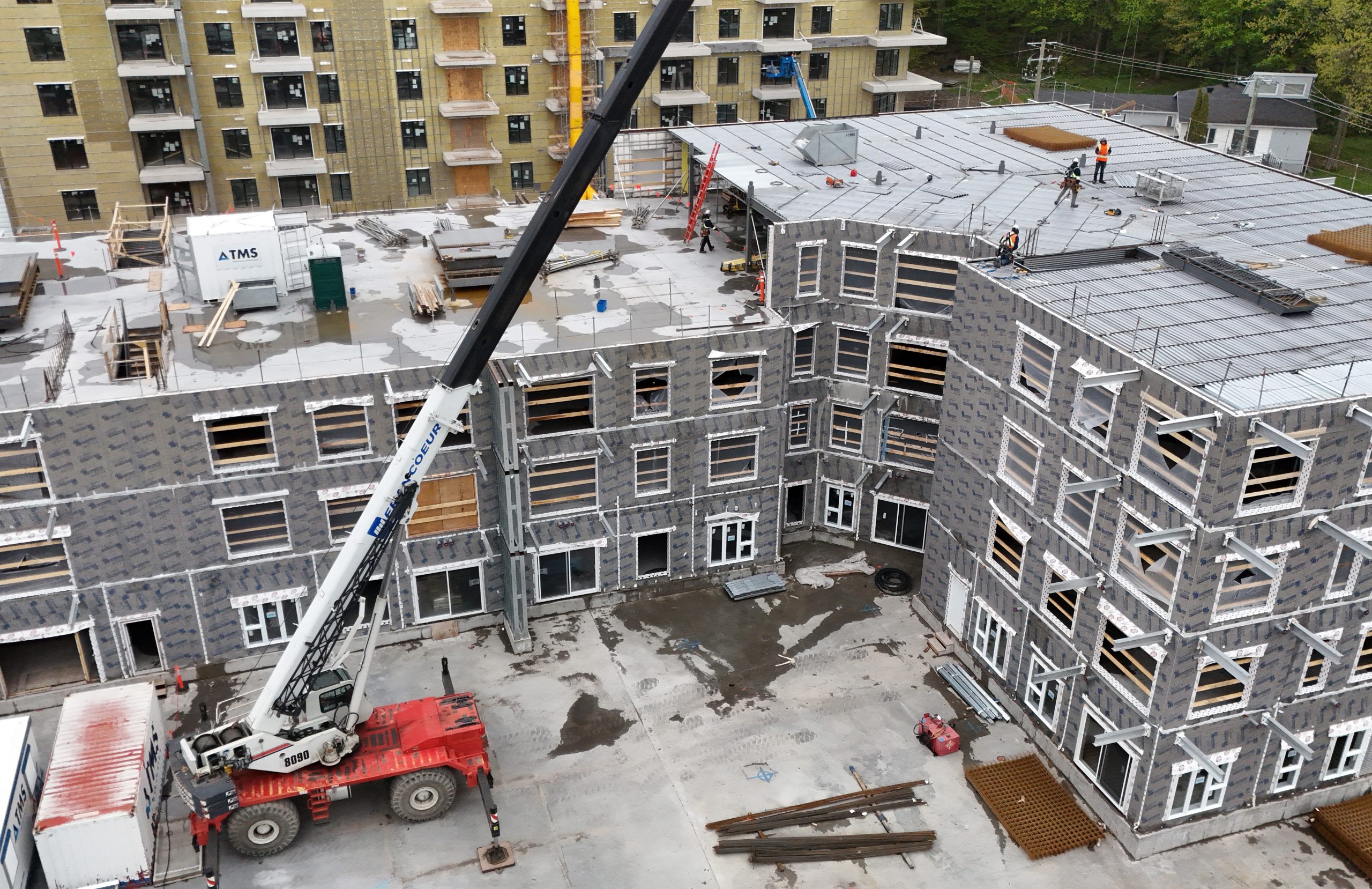

The intention of three major real estate developers – Groupe Mach, Cogir Immobilier, and Groupe Devimco – to build 2,500 housing units for the homeless in Montreal, revealed in November by the newspaper La Presse, captured the public imagination. They propose to build at no profit and then hand over the buildings to the Société d’habitation du Québec (Quebec Housing Corporation) to keep the units off the market.
This is the most significant, but not the only, private sector initiative increasingly involved in social housing. Examples include Toit à moi, which aims to purchase and offer 1,500 affordable condominiums to people aged 55 and over experiencing homelessness by 2035, and Mission Unitaînés, which is slated to complete the delivery of 17 buildings with 100 affordable housing units for seniors across Quebec by 2027. Another example is UTILE, a non-profit organization that focuses on student housing.
Protect the teams
But in the case of the three major developers, the initiative is surprising because it’s not a non-profit organization and doesn’t fit into a profitable business model. Anne Cormier, a specialist in social housing issues at the Faculty of Environmental Design of the School of Architecture at the University of Montreal, believes they will still find it worthwhile in a market where demand for the condos and luxury apartments they usually build has collapsed. “They’ve built too many, the market is completely saturated, and they’re likely looking for work. The goal, in this case, is to avoid destroying the teams they’ve taken the time to build.”
Hélène Bélanger, a professor in the Department of Urban and Tourism Studies at UQAM and a specialist in social housing, agrees. “Perhaps there isn’t the same profit margin as in a private, for-profit construction project, but their business is running, their workforce is working, so it keeps the machine running.”
The homelessness that disturbs
Another motivation mentioned is that of image and the urban environment, explains Louis Gaudreau, also a social housing expert at UQAM’s School of Social Work. “It’s really clear that the issue of homelessness is perceived by the business community as a hindrance to economic growth or, at the very least, to the smooth running of business.”
Hélène Bélanger goes further, emphasizing that “this homelessness is becoming increasingly visible, but it’s also becoming more and more ‘scary,’ in the sense that we’re seeing many very serious cases that we didn’t see as frequently not so long ago. It gives a bad image for businesses.” According to her, the business community has long tolerated it, “but now the problem is too significant. We can no longer simply ignore it or push it to the back of a few blocks. Homelessness issues exist everywhere now, in the suburbs, in rural areas, and the business community has a vested interest in addressing the problem.”
“These major developers have contributed to the housing crisis by building large condo projects, both rental and sale-oriented, that are unaffordable for most households,” she continued. “And now, there’s an untapped market opportunity because the government is neglecting social housing construction, so there’s a critical need, and they want to fill that gap in social housing construction.”
State failure
Private initiatives are multiplying precisely because of government disengagement, says Véronique Laflamme, spokesperson for the Front d’action populaire en réaménagement urbain (FRAPRU), an organization that has been advocating for the construction of social housing for decades. “We have the impression that governments, particularly the Quebec government, are abandoning their role as project managers. The Quebec government lacks a clear vision and quantified development objectives, and it is falling behind the private sector.”
Georgia Cardosi, an assistant professor in the Faculty of Environmental Design at the School of Architecture of the University of Montreal, believes that the growing involvement of the private sector “is much more than a rejection of the government. What we are experiencing is a general failure of the state’s presence in addressing the main housing issue. Many citizens can no longer pay their rent, but we saw this coming a long time ago. So there is inefficiency, inaction on the part of the state.”
“We are not simply in a housing crisis,” she said, “but rather in a fairly significant crisis of values, where the state is increasingly absent from issues at the heart of civic life.”
Hélène Bélanger also makes a similar observation that goes beyond housing. “The current government’s disengagement has been clear for several years now, and we see it in several areas, not just housing. The government is currently relying heavily on private enterprise to take over social programs and, to some extent, community initiatives. This disengagement is evident on many fronts.”
Privately funded, using public money
Public authorities are not entirely absent, however. These projects can be carried out at low cost, notably because the land is most often provided by the municipalities. And the government, yes, is dipping into the public treasury, Louis Gaudreau points out. “What these philanthropists are proposing is something that isn’t called social housing, but has almost all the characteristics of it. We’re talking about building housing that will become the property of the state, of municipal housing authorities, and in which tenants will pay rent proportional to their income. And that’s the definition of subsidized public housing. And what’s ironic is that the official policies of the Quebec government don’t even propose this.”
What Quebec is doing, he says, is providing piecemeal funding. “Rather than creating programs or fitting projects into programs, we’re providing piecemeal funding. Unitaînés, for example, is money that was given by decree to the Maurice group to carry out the project they submitted.” And the land itself was all provided by the 17 municipalities involved.
No public funding has yet been granted to the three promoters, but they do not hide their desire to obtain multi-decade mortgage financing from Quebec.
This is precisely why, according to Georgia Cardosi, all these projects need to be closely monitored. “We must ensure the sustainability of the public resources allocated to these projects, even when the private sector is in charge. Public resources, land, subsidies, and loans are always involved. We must ensure that these public resources lead to housing that will remain a lasting collective asset.”
The most vulnerable left behind
The decision to give free rein to private developers in social housing is not without consequences. “What worries me more is that these developers are used to building for people without particular issues,” argues Anne Cormier. “If we think about the most visible people, there are still many who have organizational problems and who need support to be able to return to more comfortable lifestyles.”
She notes that the three major developers are talking about building buildings with 200 to 300 units. However, she points out, “there are many people who need support to reintegrate into society, and 300 people is far too many for one building, for this clientele. I find it somewhat worrying that such companies are embarking on housing projects intended for a different population without necessarily understanding the challenges involved. Generally, for people who have certain adjustment difficulties, we’re talking more about a maximum of 50 units.”
In other words, these developers could be catering to a very specific clientele: the new cohort swelling the ranks of the homeless because they are unable to find affordable housing. In the November 24th article in La Presse, Vincent Chiara, president of Groupe Mach, made no secret of his desire to select tenants without addiction or mental health issues, even going so far as to acknowledge that real estate developers were largely responsible for pushing these people out of their homes.
Loss of confidence
Beyond these immediate considerations, Georgia Cardosi makes no secret of her concerns about the long-term consequences of this transfer of responsibility from the public to the private sector. “It’s absolutely negative because it greatly diminishes the purpose of the state, the government, and the public actions that need to be implemented. It undermines citizens’ trust in public authorities and risks triggering a series of other problems that we may not see at the moment, namely opening the door to other types of solutions that are not necessarily desired, either by governments or by citizens themselves.”
Most experts point out that some European countries have addressed the housing problem through the massive construction of social housing, but “there isn’t the political will here to be an active participant, promoter, and developer of housing to ensure that people are housed,” laments Hélène Bélanger. “That’s why private actors will try to take over because there’s room for them. And I think that’s somewhat what the government wants because they can continue to disengage by saying, ‘We have large developers with a social conscience who agree not to make a profit to build these social housing units.’”
“So, the equation works well here, we’re in favor of a fully private system. The private sector is there to meet needs, but it would be very surprising if it were there to meet the needs of the most vulnerable and those with more serious cases.”
–This report by La Presse Canadienne was translated by CityNews