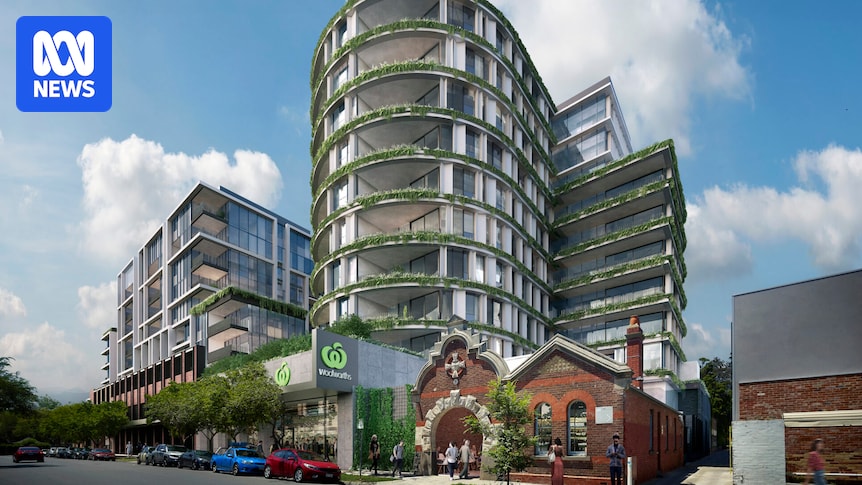
Woolworths has been accused of exploiting affordable housing development schemes to ram through new supermarkets and luxury apartment buildings, some of which have previously been blocked by local councils and a state planning tribunal.
The retail giant is planning at least 10 new developments around the country that incorporate new supermarkets and apartment complexes as part of its push into the residential property market.
In New South Wales and Victoria, the company has been utilising fast-track schemes that allow developers to sidestep councils and apply directly to the state government for approval.
Two of its projects in Victoria have been blocked or scaled back by councils and the Victorian Civil and Administrative Tribunal over the past three years, amid concerns they would bring too much additional traffic, not fit within the local character or overshadow existing buildings.
But Woolworths has circumvented local planning processes by accessing a state government fast-track program available to developers if they devote a portion of units to affordable rental housing.
ABC Investigations is looking into affordable housing schemes around Australia
If you live in affordable housing, work in the sector or know more, contact Pat McGrath: [email protected]
In one case, Woolworths altered its original plans for a five-storey apartment complex in the Melbourne suburb of Glen Iris and added a separate annex building that included six affordable rental units.
Australian Housing and Urban Research Institute managing director Michael Fotheringham said the retrofitted design appeared to be an example of Woolworths gaming the system.
“Using that to get fast-track approval seems exploitative,” he said.
“It’s clearly not the intent of these schemes.”
Michael Fotheringham says Woolworths’s Glen Iris project seems “exploitative” of the Victorian development fast-track scheme. (ABC News: Billy Cooper, file photo)
New South Wales and Victoria have introduced fast-track schemes aimed at meeting targets agreed under the 2022 National Housing Accord, in which the state, territory and federal governments pledged to build 40,000 social and affordable rental homes by 2029.
Dr Fotheringham said the schemes were a good idea in principle, but could be vulnerable to developers looking to push ahead with projects without properly integrating affordable housing into their apartment buildings.
‘Affordable’ housing tenants face $55/week rent hike
Alix and Tiarn say their experience highlights flaws in the model the Victorian government is using to redevelop its aging public housing towers.
“If that’s what the affordable housing we’re bringing on looks like, then we’ve got a problem,” he said.
“In the good developments with mixed tenure, there is no distinction between the properties that are social and affordable housing and those that are owner-occupied or privately rented.”
Woolworths’s Glen Iris development includes a new supermarket and an apartment building with 58 units.
Stonnington Council rejected Woolworths’s planning application for the complex in 2020 — a decision confirmed by the Victorian Civil and Administrative Tribunal (VCAT) after a 12-day hearing in 2022, which found “the overall scale, form and massing of the built form is unacceptable”.
New approach
But in June last year, Woolworths submitted a revised planning application to the state government’s Development Facilitation Program — a fast-track scheme that allows developers to seek approval from the state planning minister if their project devotes at least 10 per cent of units to affordable housing.
Projects approved by the minister through the program cannot be appealed at VCAT.
A government assessment of Woolworths’s application shows it addressed some of VCAT’s concerns, including lowering the height of the development by one storey and reducing the total number of units from 80.
It also added the collection of six affordable rental units as an annex to the main complex.
Rendered drawings show the main building towering over the three-storey affordable housing annex, which the planning permit says must be owned or managed by a community housing charity after the development is built.
The proposed three-storey annex to the Glen Iris development would contain six affordable rental units. (Supplied: Cera Stribley Architects / Time & Place)
Only three car spaces have been allocated to residents of the six affordable units, while 120 car spaces have been allocated to the 58 apartments in the main building.
Victorian planning minister Sonya Kilkenny approved the project in October last year.
Last month, Woolworths submitted an application to slightly increase the number of units in the complex.
Construction has not yet begun at the site on the corner of Burke Road and Hope Street in Glen Iris.
Dr Fotheringham compared the project to heavily criticised developments in London and New York earlier this century, which included separate entrances for affordable housing residents — often referred to as a “poor door”.
“It will have very clear visual signals to everyone in the community that this is lesser, that this is poorer housing, and therefore the people living in it are somehow not as worthy as the people living in the main building,” he said.
Woolworths declined a request for an interview and did not respond to specific questions.
“While our main focus is building for retail, across the country we own inner city sites that provide an opportunity for us to include housing alongside a supermarket,” it said in a statement.
“These mixed-use developments cater to increased demand for people to be able to shop, work and enjoy themselves, all within a close proximity to where they live.”
Woolworths’s partner in the project, developer Time and Place, defended the design.
“We developed the design of the affordable housing component of this development in consultation with community housing providers,” a spokesperson for the developer said.
“The feedback from these providers was that offering the affordable housing in the main building would increase their overheads — they would have to pay higher strata fees, insurance and other overheads.
“By separating these units onto another title, we have been able to keep those costs down for the community housing provider that will eventually operate them.”
Sonya Kilkenny approved the Glen Iris project in October last year. (AAP: Nadir Kinani, file photo)
Ms Kilkenny declined to do an interview but, in a statement, defended the decision to approve the project.
“We know it’s been too difficult to build homes in our more established suburbs — that’s why we’ve been overhauling our planning system so more Victorians can live close to jobs, transport and services,” Ms Kilkenny said.
Resident frustration
Glen Iris resident Adrian Purnell, who was part of the campaign against the Woolworths project, said he was shocked by the minister’s decision to override the council and VCAT.
“It was a complete kick in the guts,” he said.
“You start to question, why even have the system? If you go to all this effort, you have your say and it feels democratic, it feels OK, and then you get overridden.”
Mr Purnell, who is a retired automotive engineer, spent days filming and analysing traffic data to submit to the VCAT matter.
He said he felt Woolworths appeared to have gamed the system by adding the affordable housing annex.
“They’ve just tacked these around the side … and by doing that they’ve been able to get it through,” he said.
Adrian Purnell describes the minister’s approval of the Woolworths project as “a complete kick in the guts”. (ABC News: Patrick Rocca)
Levy option available
Woolworths also used the Development Facilitation Program to win ministerial approval for a supermarket and 11-storey apartment complex in the Melbourne suburb of Elsternwick that was rejected by the local council in 2019 and again in 2022.
It won approval from VCAT for a scaled-back development in 2022 but, in December last year, resubmitted its design to the state government’s fast-track scheme.
In July, Ms Kilkenny approved the project, which will be built on the former site of the ABC’s Melbourne studios.
The Woolworths supermarket and apartment complex proposed for Elsternwick. (Supplied: Fender Katsalidis Architects)
However, there is no guarantee the affordable units will ever be built.
A planning permit issued by the Victorian government in July gives Woolworths the option of making an “alternative contribution” to affordable housing supply.
Under the Development Facilitation Program’s rules, developers can opt to pay 3 per cent of the total value of a project as a levy into a state social housing fund in lieu of actually providing affordable housing units.
Simone Zmood, mayor of the Glen Eira council that rejected Woolworths’s original Elsternwick plans, said the decision meant there was no obligation for the project to add affordable housing to the local area.
“[The] permit allows the applicant to provide a cash contribution in place of affordable housing, without any stipulation that this contribution be used within Elsternwick or Glen Eira,” she said.
“Given that affordable housing is a crucial criterion for the Development Facilitation Program fast-track pathway, we have concerns about how the minister has addressed this requirement.”
Simone Zmood says Woolworths is not obliged to provide any affordable housing in the area. (Facebook: Glen Eira City Council)
Ms Kilkenny did not respond to questions about why Woolworths was given the option of making an alternative contribution to affordable housing.
“We make no apologies for delivering more homes where they’re needed most, including in Elsternwick and Glen Iris, which are well connected to transport, services and jobs,” she said in her statement.
Woolworths did not respond to questions about whether it planned to build the affordable housing units or opt to pay the levy.
“In line with federal and state government policies, we’ll continue to navigate the inclusion of affordable housing to unlock good urban infill development,” its statement said.
Time limit on affordable units
In New South Wales, Woolworths is facing criticism over its use of a fast-track development scheme to seek approvals for developments in Neutral Bay and Gladesville.
Woolworths has promised to allocate 10 units in its proposed 97-apartment complex in Neutral Bay to affordable housing as part of its application to the NSW government’s Housing Delivery Authority (HDA) — an agency set up last year to fast track new developments.
Woolworths says it will offer the units as affordable housing for 15 years.
An artist’s impression of the Woolworths development proposed for Neutral Bay, on Sydney’s north shore. (Supplied: Koichi Takada Architects)
Affordable housing is among the criteria assessed by the HDA when deciding whether a project should be declared a State Significant Development (SSD).
A project deemed to be an SSD can bypass local government and seek planning approval directly from the state.
As part of its development application, Woolworths has asked the Department of Planning for a rezoning review of the site that would allow it to increase the maximum floor space and the height of its proposed building from 31 metres to 44 metres.
Zoe Baker wants the affordable housing component of the development to remain. (YouTube: North Sydney Council)
North Sydney Mayor Zoe Baker said that in return, Woolworths should be required to offer the affordable units in perpetuity.
“The increased height and density will remain for the life of the building and the affordable housing component ought to, too,” she said.
NSW Planning Minister Paul Scully said the state government welcomed the inclusion of affordable housing in new developments “whether it’s for 15 years or in perpetuity”.
“Providing affordable housing for 15 years will help NSW to have a rolling supply of affordable housing stock,” he said in a statement.
Loading…